
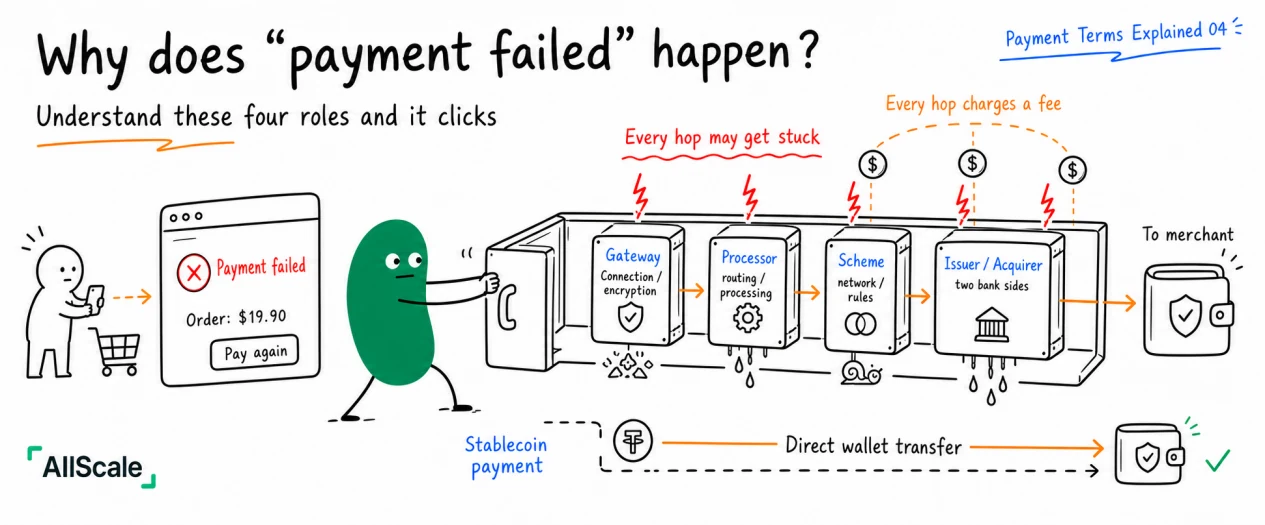
The first three posts stayed at the "front counter" — the Checkout, the invoice, the refund. Things you can see. This time we go backstage.
You hit "pay" at the checkout, and less than two seconds later the money is in the merchant's account. But in those two seconds, your money has been handed off through at least four different characters behind the scenes. Today we'll introduce them one by one.
1. Start With an Analogy
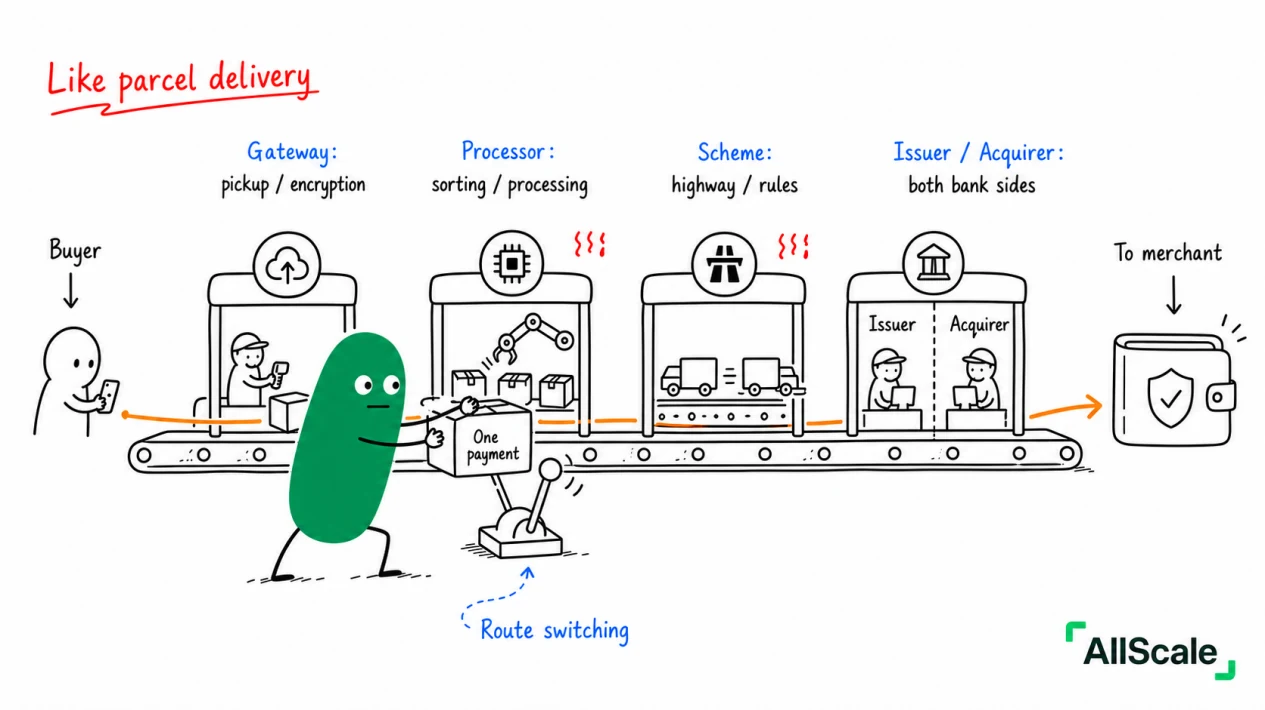
Payments are a bit like shipping a package: you only see "order placed" and "delivered," but in between there's pickup, sorting, long-haul transport, and last-mile delivery. Each step has someone doing the work, and each takes a cut.
The four roles behind a card payment are the payment world's "pickup, sorting, transport, last-mile." They map to:
- Issuer (Issuing Bank): the bank that gave the buyer their card. The buyer's money sits here. It answers the key question — does this card have funds, is this really the cardholder, can this charge go through?
- Scheme (Card Network): Visa, Mastercard, UnionPay, and so on. It doesn't touch the money itself. It's the "highway" and "rulemaker" connecting all the banks — setting standards, doing routing, making sure a card from one bank works at a terminal connected to another.
- Acquirer (Acquiring Bank): the bank that signed the merchant, collecting money on their behalf. After all the back-and-forth, the money lands in the merchant's account through this bank.
- Gateway & Processor: these two sit on the merchant side, forming the technical middle layer. Gateway handles "data transport," securely encrypting and passing the buyer's card details into the system. Processor handles "flow execution," shuttling authorization and clearing requests between all the parties.
Many companies (like Stripe) do both, which is why they often get treated as one role.
2. Four Roles, One Payment Journey
Here's what actually happens in those two seconds:
Buyer hits "pay" → Gateway collects and encrypts the card info → Processor initiates the authorization request → routed through the card scheme to the issuer → issuer checks balance and risk, approves or rejects → result comes back to the merchant along the same path.
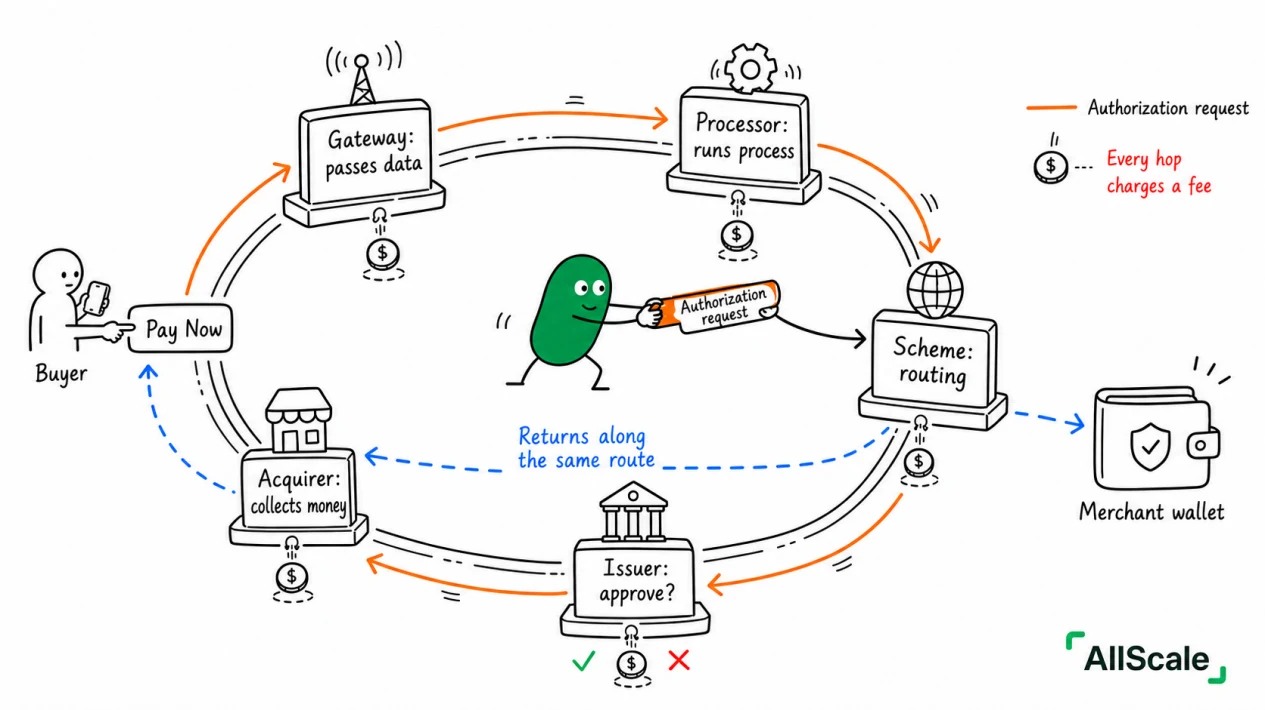
That only covers the "authorization" step. The money hasn't actually moved yet (the real charge, clearing, and settlement are in the next post). But you can already see two important things:
- First, money never goes "directly" from buyer to merchant. It gets relayed through four roles, and every hop takes a fee — which is the setup for the earlier hint.
Why fees are so high, post #6 will break down.
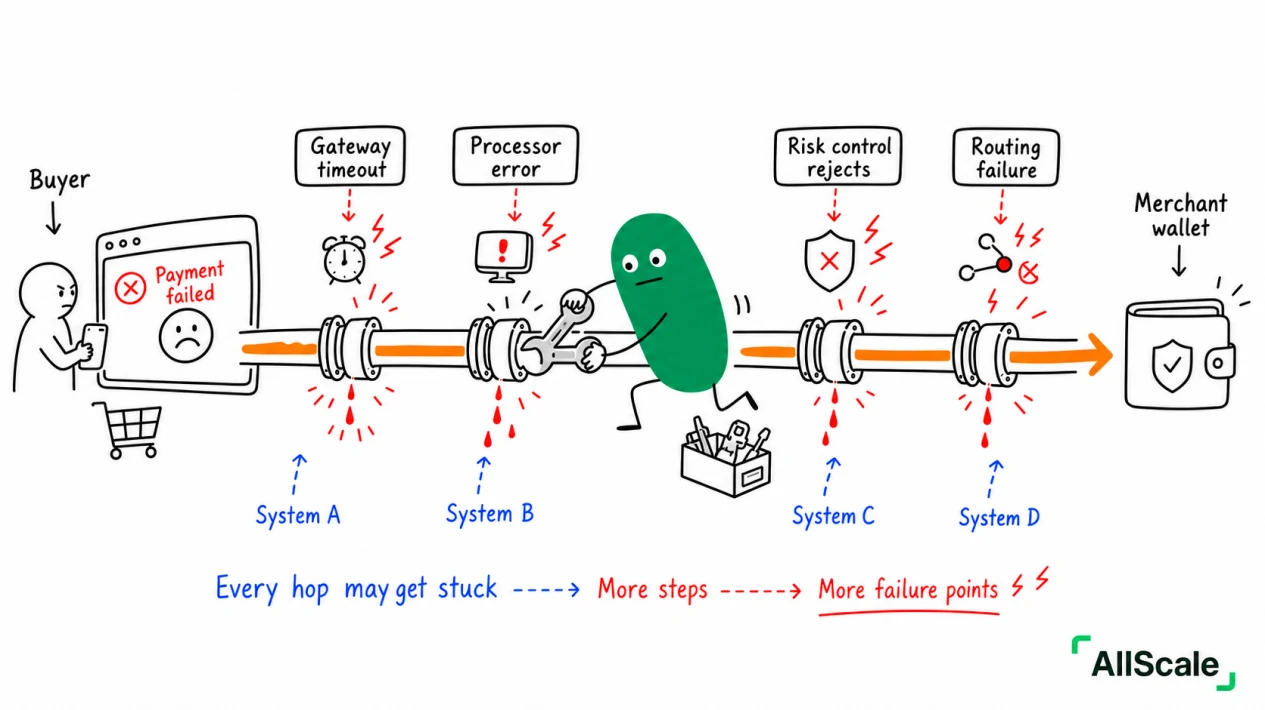
- Second, every hop can get stuck. Gateway timeout, processor error, issuer risk rejection... any one of them breaks and you get that maddening "payment failed"
message. More hops mean more failure points.
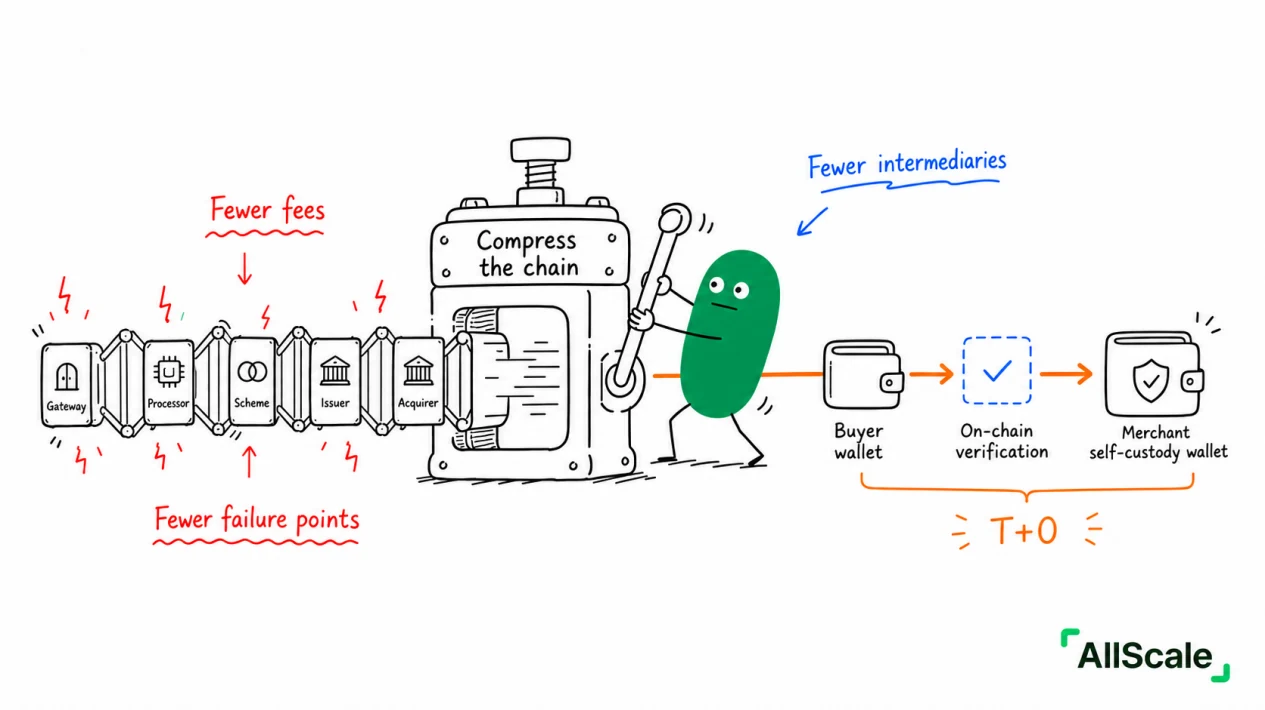
3. Stablecoins: Compressing Four Roles Into One
Action Back to what we do every day. The stablecoin payment path is completely different:
Buyer's wallet → transfers directly to merchant's wallet → on-chain confirmation done.
No issuer, no card scheme, no acquirer relay. Fewer middlemen means fewer fees, fewer failure points, and less waiting.
Of course, there are always two sides (we covered this in post #3 on chargebacks): those four roles take a fee at every hop, but they also provide credit backing and dispute handling. Stablecoins remove the middlemen, and they hand that protection back to the two parties in the transaction — which is why they're a better fit for B2B, cross-border, and well-defined delivery scenarios.
AllScale is built on exactly this "middleman-free" path: the money goes straight into a wallet the merchant controls, skipping the long relay.
Wrap-Up
Issuer: the buyer's money is here, and it approves the charge. Scheme: doesn't touch the money, connects everyone, sets the rules. Acquirer: collects on the merchant's behalf, and the money lands through it. Gateway + Processor: the tech layer on the merchant side, one transports data, the other runs the flow.
One line: your money gets relayed through four roles behind the scenes, every hop takes a fee, every hop can fail — that's why traditional card payments are expensive and error-prone.
Next time we pull the camera back further: after authorization, how does the money actually get "charged," then "cleared and settled" into the merchant's account? We'll break open Auth, Capture, Clearing, and Settlement — the full lifecycle of one transaction.