
In the last post we followed four roles handing off an "authorization" in two seconds.
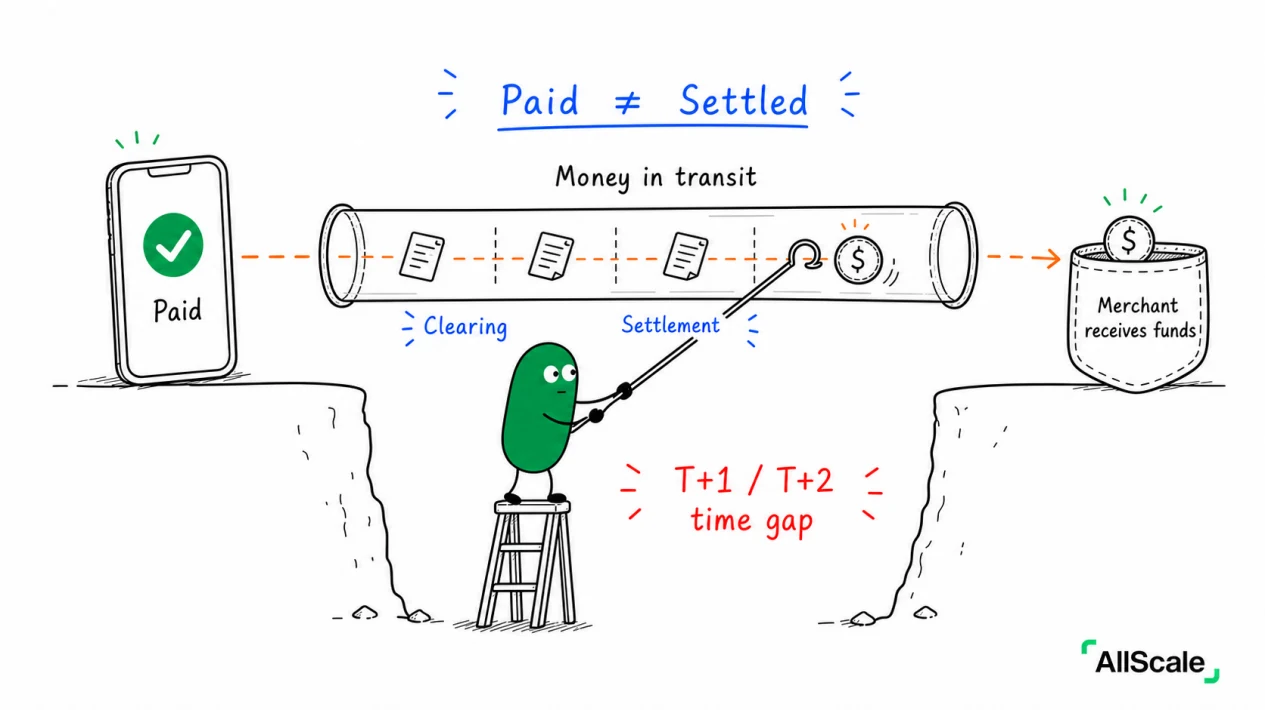
But have you ever run into this: your phone shows "payment successful," "charged," and yet the merchant says "we haven't received it"?
The gap in the middle is the rest of the transaction's lifecycle. This post covers that final stretch.
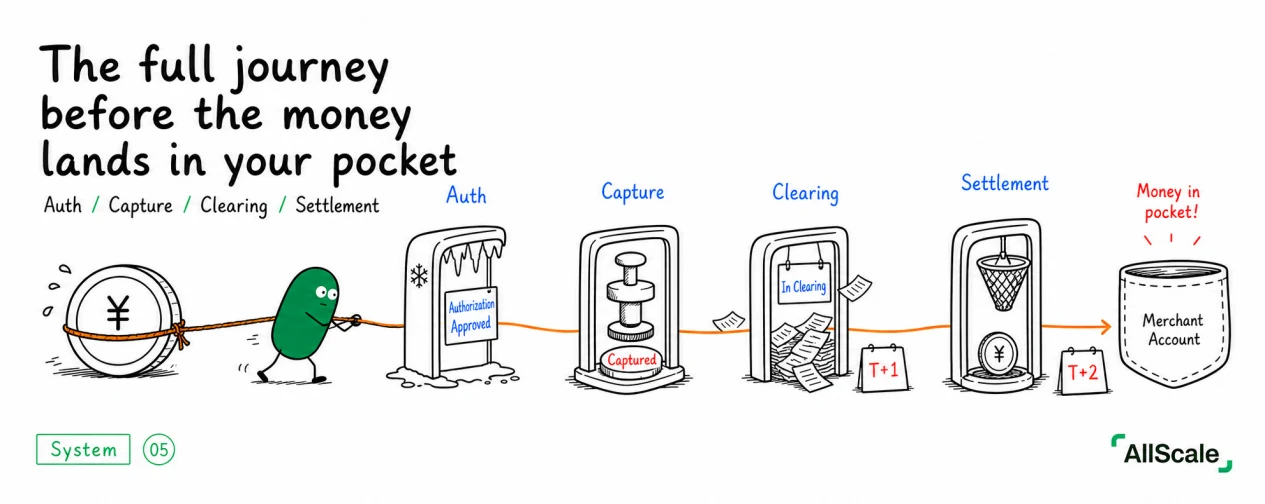
1. One Transaction, Four Steps
Take "card swiped" to "money landed" apart, and behind it are four stages:
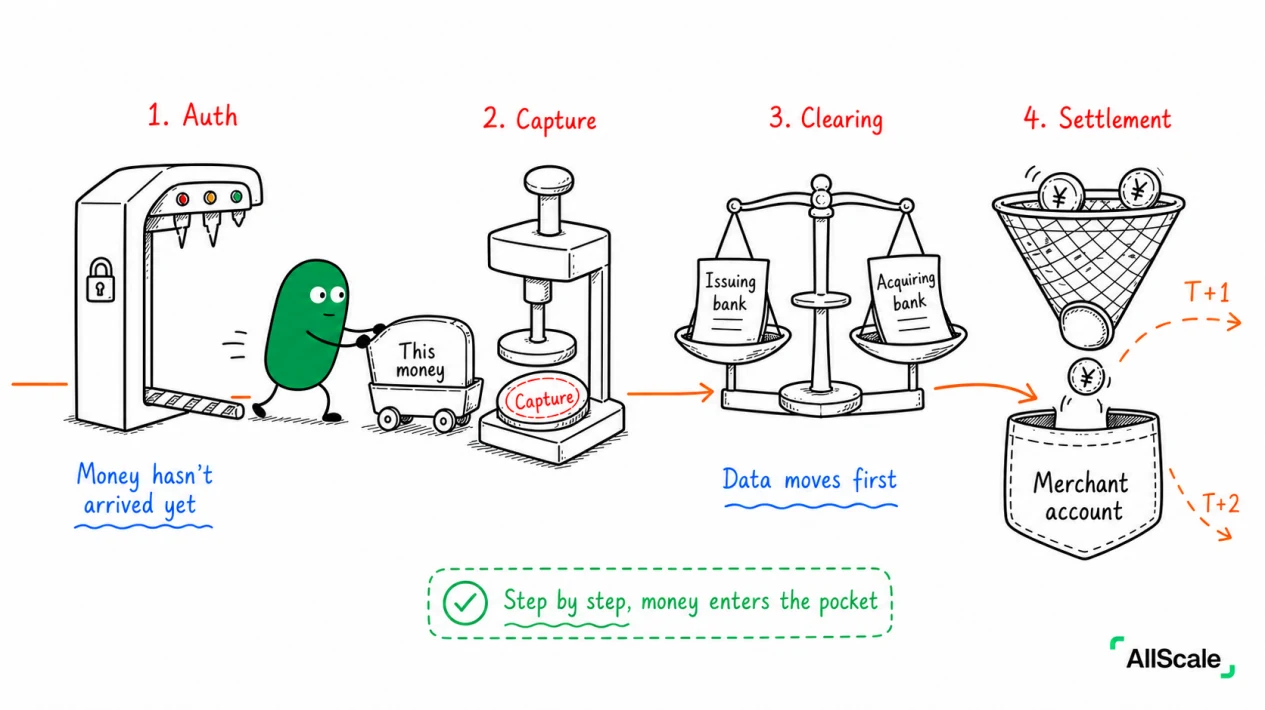
- Authorization (Auth): the issuer confirms the card has funds, it's the real cardholder, and the charge is allowed. Then it puts a hold on the amount. Note: at this step no money actually moves. It's just reserved, kind of like the deposit you leave at a hotel.
- Capture: the merchant formally initiates "I want to take that money." The held amount now becomes an actual charge. Auth and Capture can be hours or days apart — many e-commerce merchants only Capture when they ship.
- Clearing: everyone reconciles. The card scheme takes every transaction from that window and exchanges the details between issuer and acquirer to match them up. Note: every transaction goes through this step, but it's data moving, not money.
- Settlement: this is where the money actually moves — but it doesn't move one transaction at a time. Within a settlement cycle (usually daily), the card scheme takes every transaction each bank is involved in and does Netting — calculating the net amount each bank owes or is owed, then moving just that one net figure. So a bank might have millions of transactions in a day, but only settle a single net number with each counterpart (saving the pain of moving every transaction individually). The money flows to the acquirer this way, then into the merchant's account. This is the step where the merchant actually has the money.
2. Why "Charged" Doesn't Mean "Received"
This is the key insight: the "payment successful" you see usually only made it to Auth or Capture. The money actually landing in the merchant's pocket has to wait for Settlement.
Between them is the clearing and settlement cycle — the T+1 / T+2 you often hear about, meaning the money arrives 1 or 2 days after the transaction day. Cross-border, it's often longer. That's the truth behind "I paid, why hasn't the merchant received it": the money is on the road, you just can't see it.
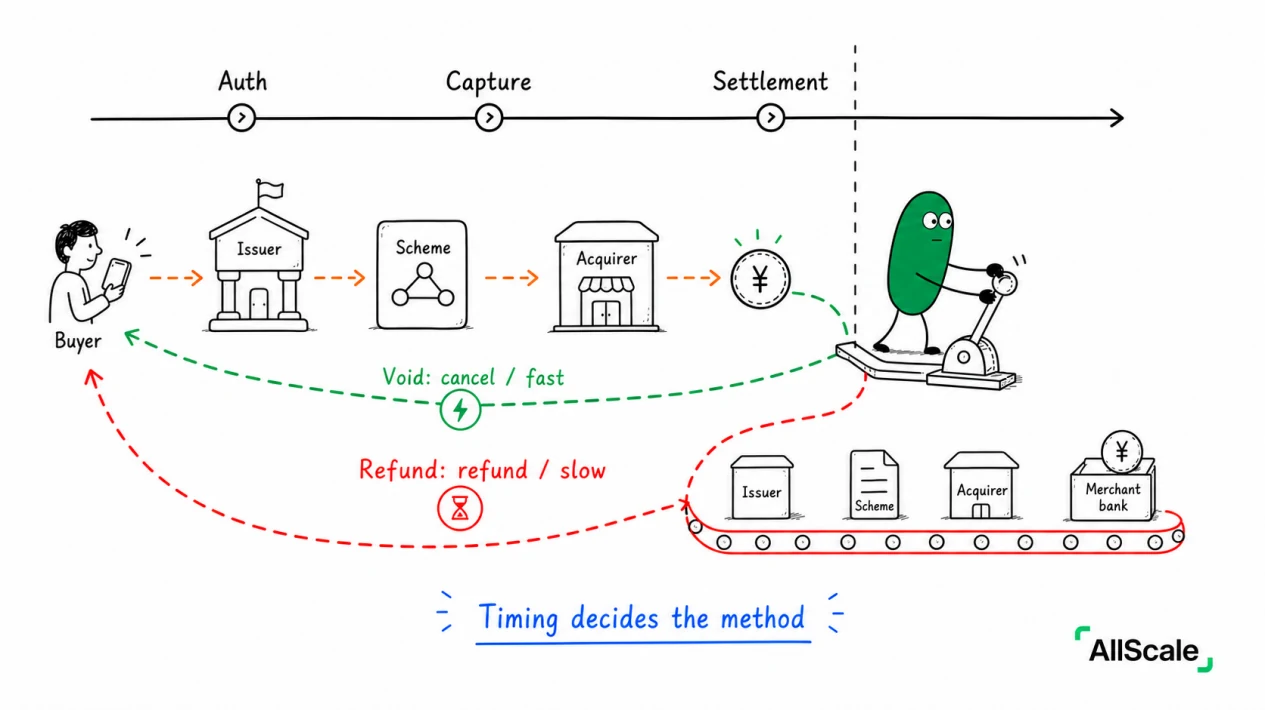
While we're here, let's revisit post #3, where we said Void and Refund are two different things. Now you can see why:
- Before Capture / Settlement, the money hasn't actually moved, so you can Void the hold directly.
- Once Settlement is done and the money has landed, the only path is a Refund, sending it back along the same route.
Different points in time mean different ways to reverse. That time gap also has a side effect called Float: the money has left the buyer but hasn't reached the merchant, sitting in the system in between. Whoever holds it earns interest. We'll get into this in post #8 on cross-border.
3. Stablecoins: Almost No "Lifecycle" at All
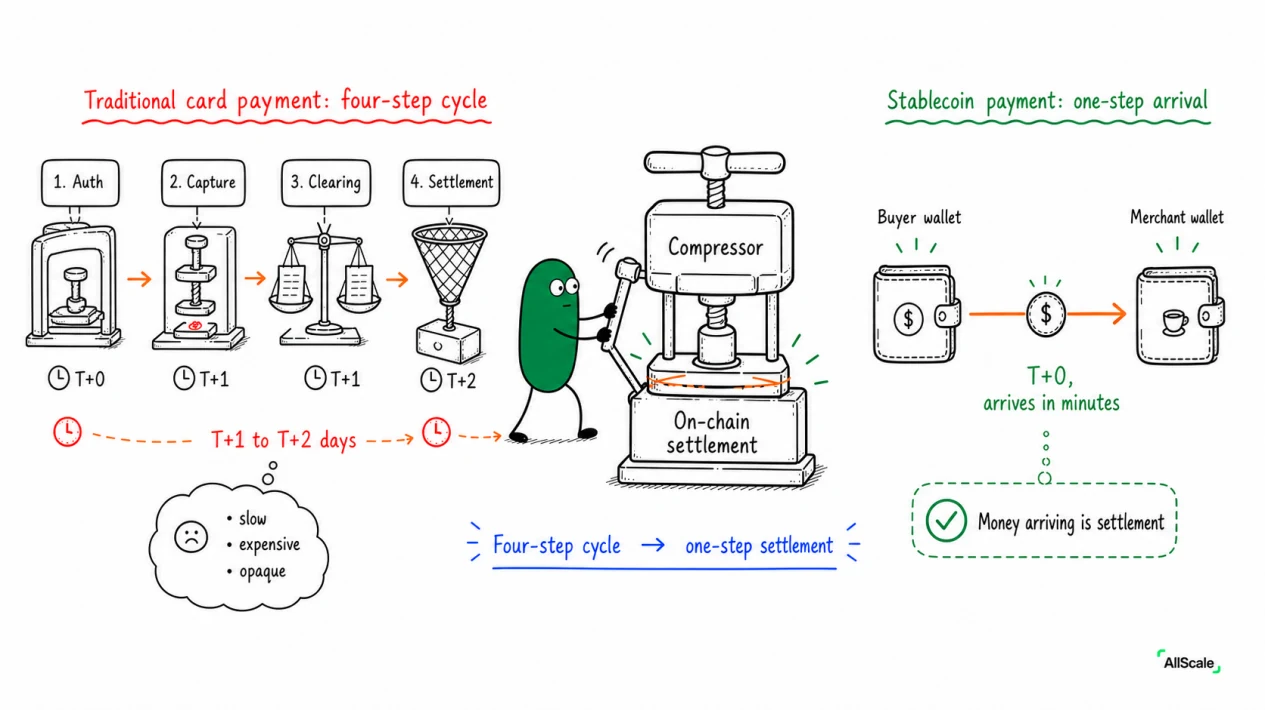
Back to what we do every day. On-chain stablecoin transfers basically compress those four steps into one:
Buyer's wallet sends → on-chain confirmation → merchant's wallet receives.
There's no "hold now, charge later," no T+1 / T+2 clearing and settlement cycle. Onchain confirmation (usually seconds to minutes) is final. The merchant has the money on the spot, and can use it on the spot. That two-day Settlement in traditional payments is a single "block confirmation" on-chain.
Like the "irreversibility is a double-edged sword" from post #3, "fast" has two sides too. The traditional clearing and settlement cycle is slow, but that window is also an error-correction window, with room to intervene. Stablecoin T+0 settlement is very efficient, but the tradeoff is no buffer. For merchants sensitive to cash flow, especially those doing cross-border collection, "the money lands when it lands, no more two-day wait" is a real, tangible benefit.
AllScale is built to erase that T+1 / T+2 gap between "shows as paid" and "actually received."
Wrap-Up
Auth: the issuer confirms the charge is possible, puts a hold on the amount, no money moves yet. Capture: formally initiates the charge, the hold becomes an actual debit. Clearing: everyone reconciles, figures out who owes whom what. Settlement: money actually lands in the merchant's account, typically T+1 / T+2.
One line: "charged" isn't "received." Traditional payments go through four steps and take a day or two to actually land. Stablecoins do it in almost one step.
Next time we'll answer the question left hanging since post #4: every role on that path takes a cut, so what's your fee actually made of, and who's taking what? We'll break open MDR, Interchange, and Scheme fee — all the pieces hidden behind that fee rate.