
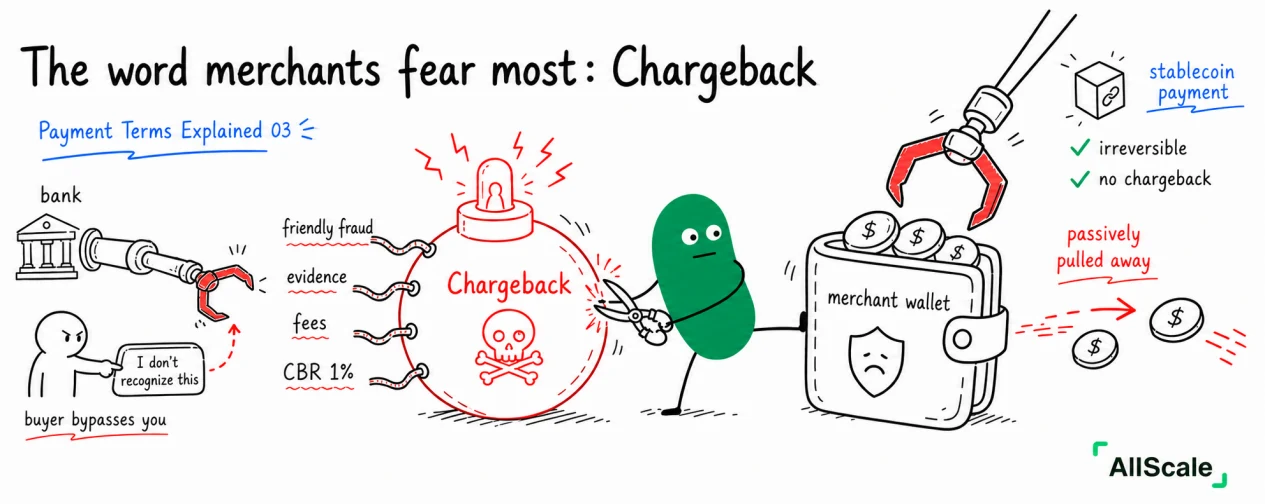
We closed the last post with: getting paid doesn't mean case closed. Why? Because in the card payment world, a payment that lands in your account today can still get pulled out months later.
This post covers two words that keep merchants up at night: Refund and Chargeback.
Along the way, we'll explain why the same event plays out completely differently in the stablecoin world.
1. First, Untangle Three Different Things: Void, Refund,
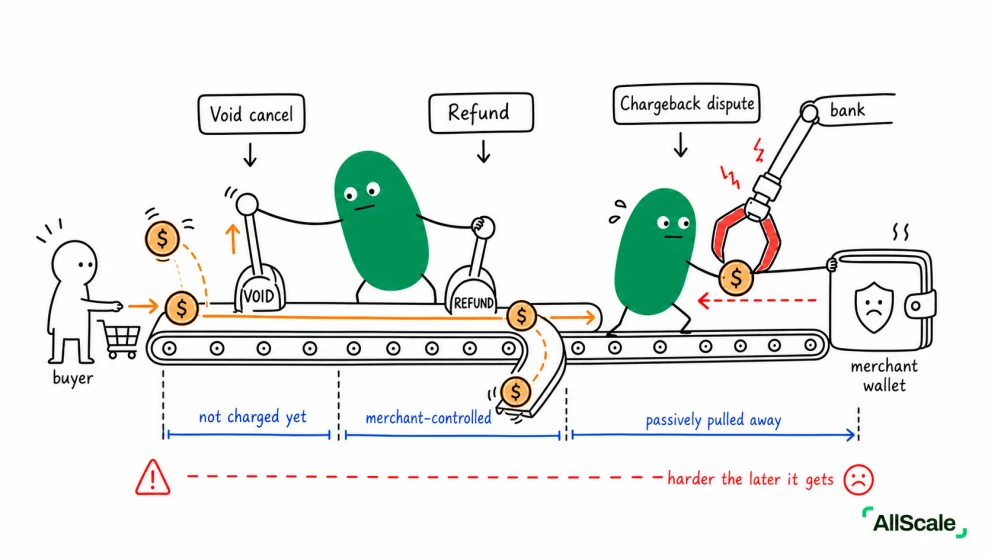
Chargeback Money moves from buyer to your account through several checkpoints. Reversing it at different checkpoints has completely different names and consequences:
- Void: the transaction was authorized but not yet actually charged, and you cancel it. The hold on the buyer's card is released, and it's as if the transaction never happened. The cleanest option.
- Refund: the money has already settled into your account, and you actively send it back to the buyer. You're the one making the call — controlled, deliberate.
- Chargeback: the buyer doesn't come to you. They go straight to their issuing bank and say "I don't recognize this transaction," and the issuer forcibly pulls the money back out of your account. You have no control.
The words "authorization," "charge," and "settlement" here are checkpoints in the lifecycle of a card transaction, which post #5 will unpack. For this post, just remember one thing: the later it is, the harder the reversal, and the worse it gets for the merchant.
2. Why Chargebacks Are a Merchant's Headache
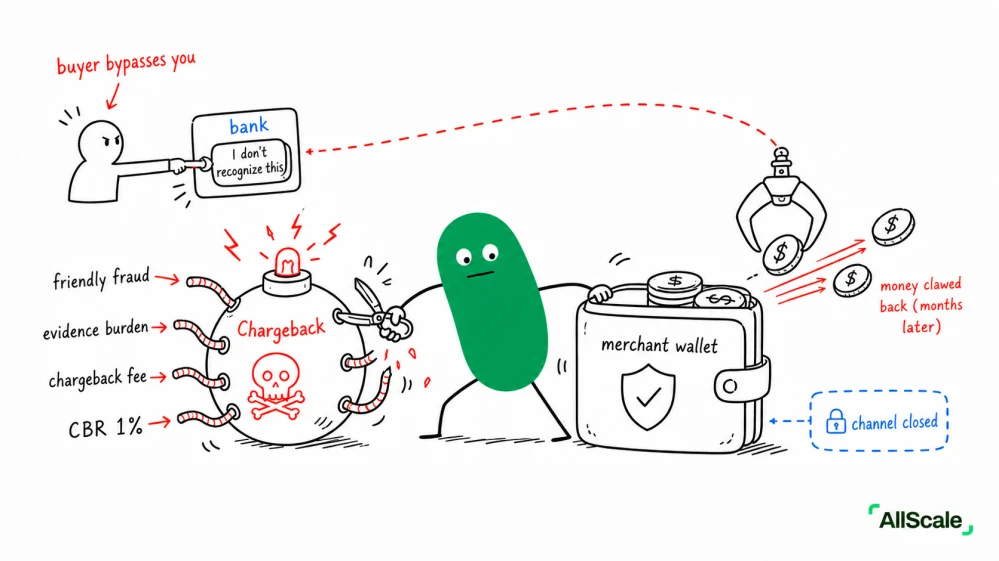
Chargeback started out as a good mechanism for protecting consumers: if a card gets stolen, the goods never arrive, or the merchant plays dirty, the cardholder can pull the money back through the issuer.
Sounds reasonable. The problem is it's easy to abuse:
- Malicious chargebacks / friendly fraud: the buyer actually received the goods or used the service, but claims "never got it" or "wasn't me" to the bank, files a chargeback, and walks away with a freebie.
- Burden of proof is on the merchant: you have to dig up shipping records, delivery confirmations, chat logs to appeal. The process is long and the win rate isn't great.
- You pay either way: every chargeback triggers a chargeback fee from your acquirer, whether you win the appeal or not.
- Chargeback rate is a red line: chargeback rate (CBR) = number of chargebacks ÷ total transactions. Cross the card scheme's threshold (usually 1%)
and you get put on monitoring programs, hit with fines, or in serious cases, cut off from the acquiring channel entirely — which is the same as losing your business.
For a lot of merchants, especially cross-border sellers, digital goods sellers, and anyone with high ticket prices, Chargeback isn't a casual "oh, someone got a refund."
It's a risk bomb that can go off at any time.
Visa has rolled out a mechanism called RDR (Rapid Dispute Resolution) that lets merchants set rules upfront and auto-refund before things escalate into a formal chargeback. But this is a patch on top of the old system, not a real fix, and merchants still deal with the pain of chargeback risk.
3. Stablecoin World: Irreversibility Is a Double-Edged
Sword On-chain transfers have a fundamental property: once confirmed, they can't be reversed. No issuing bank can force money back, and the concept of "chargeback" simply doesn't exist.
That's a real benefit for merchants:
No chargebacks means no friendly fraud, no chargeback fines, no CBR red line. The money you receive is final. You don't have to worry about it getting yanked back months later, and cash flow certainty goes up a lot.
For buyers, it's the opposite — they lose the "safety net" of reversal. In card payments, if a cardholder gets scammed, pays the wrong person, or runs into a merchant that disappears, the issuer has their back. On-chain, once the money is sent, no one at the protocol level can help them get it back.
The risk didn't vanish, it just moved. It shifted from "merchants worried about chargebacks" to "buyers worried about scams." Buyers who run into a fraudulent merchant have almost no automatic remedy.
In other words, stablecoins remove the "hassle" of chargeback, but they also remove the "consumer protection" that came with it. The mechanism protecting buyers is no longer the payment network itself. It has to come from somewhere else: merchant reputation, dispute or escrow mechanisms on the platform (like third-party Escrow), and traceable on-chain receipts.
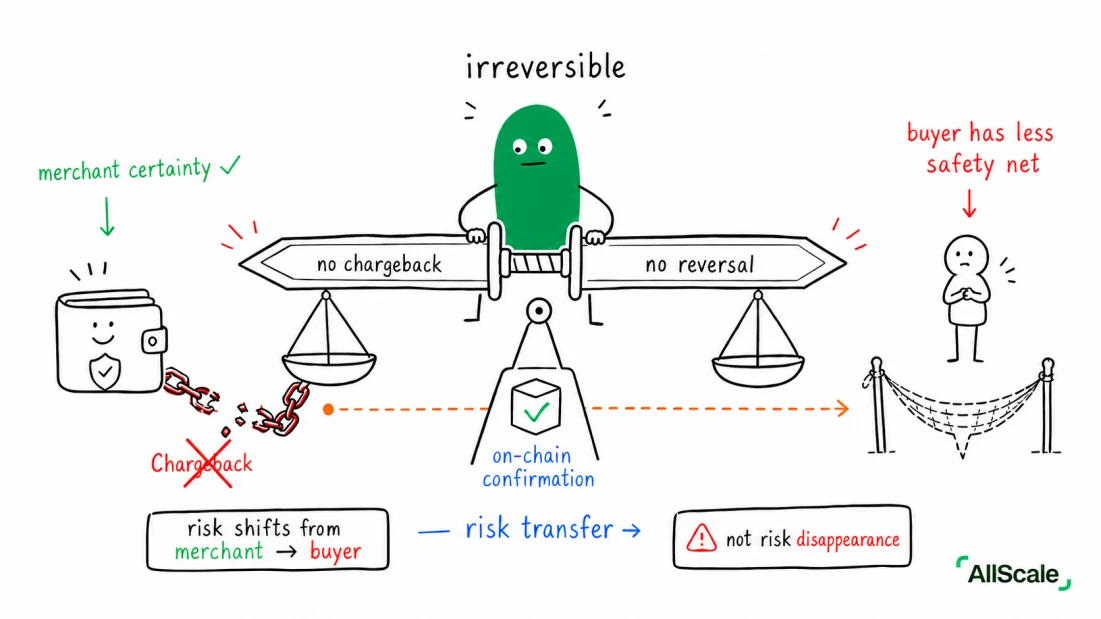
Which one is better depends on the scenario: B2B, transactions between known parties, or well-defined digital goods — irreversibility is a plus. Retail scenarios facing unknown consumers need extra trust and guarantee mechanisms to fill the gap.
4. How AllScale Handles It
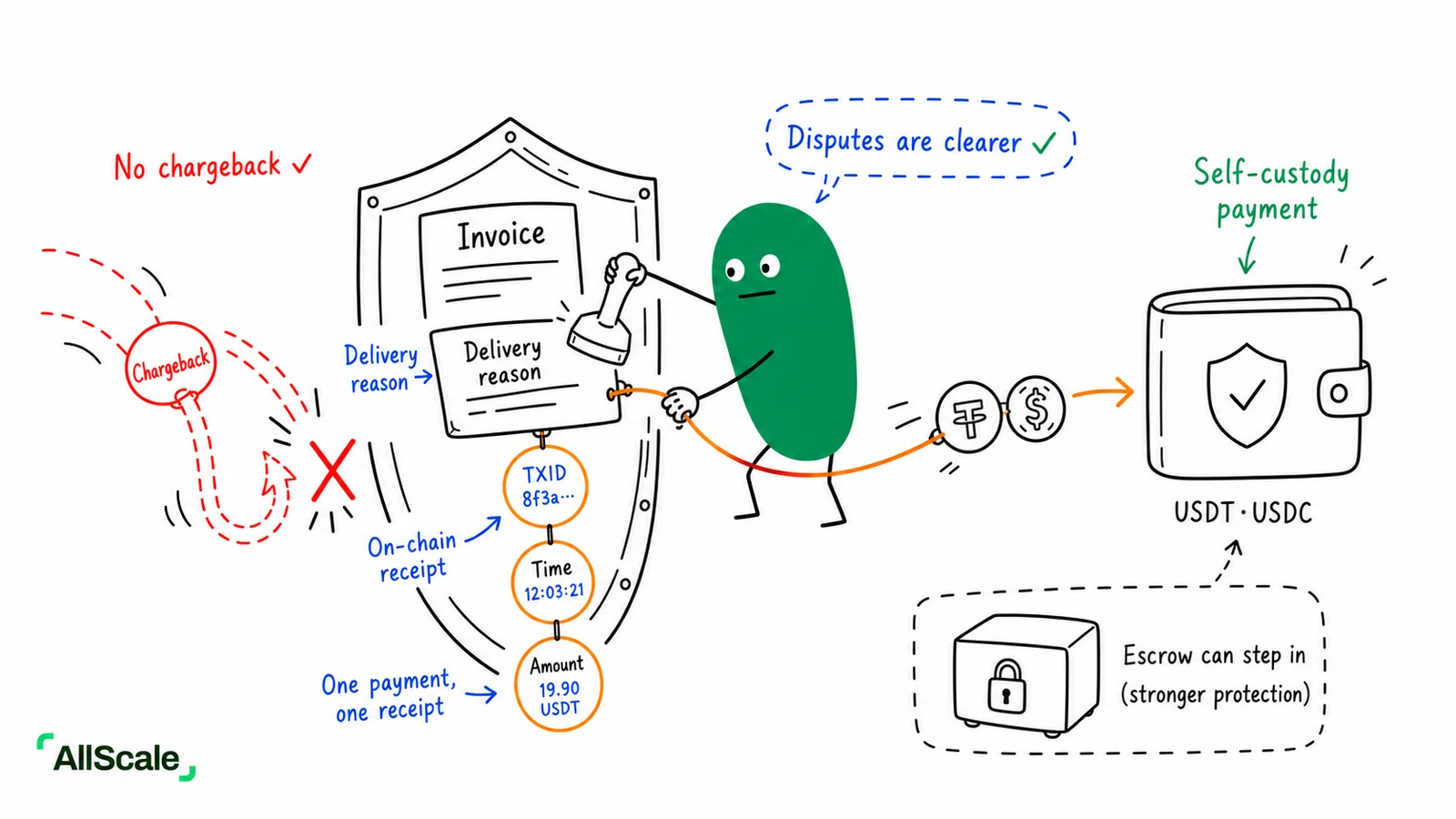
AllScale runs on stablecoins and self-custody, so it doesn't have chargeback risk by design. That fits the micro-merchant and cross-border collection scenarios it serves — most of which are B2B or well-defined services, where the merchant's biggest fear is cross-border chargebacks.
As for the "buyer protection gap" mentioned above, it's not unsolvable. Traceable onchain receipts (every transaction has a record) plus the delivery reason written into the invoice (the "reason" field from the last post's Invoicing section) already shrink the room for disputes. For scenarios that need stronger buyer protection, Escrow (third-party custody that releases funds only when conditions are met) is a standard industry solution — we'll get into this when we dive into specific cross-border scenarios later.
Wrap-Up
Void: not yet charged, straight cancel, cleanest. Refund: money has landed, you send it back yourself, controlled. Chargeback: buyer goes around you and forces the bank to pull the money, merchant is passive, pays fees, and getting past the chargeback rate threshold gets you cut off. Stablecoin irreversibility: kills chargebacks and friendly fraud, but also removes the buyer's reversal safety net — a benefit and a responsibility, depending on the scenario.
Next time we're heading behind the counter: when a buyer hits "pay," what roles does that money pass through before it lands with the merchant? We'll unpack the four characters who've been working backstage all along — Gateway, Processor, Acquirer, Issuer.