
The first thirteen articles were all about "how to collect money faster and cheaper."
But there's a cluster of words you can't dodge if you're doing cross-border or stablecoin business. A lot of people wince at the mention, and some who brush them off early end up learning the hard way.
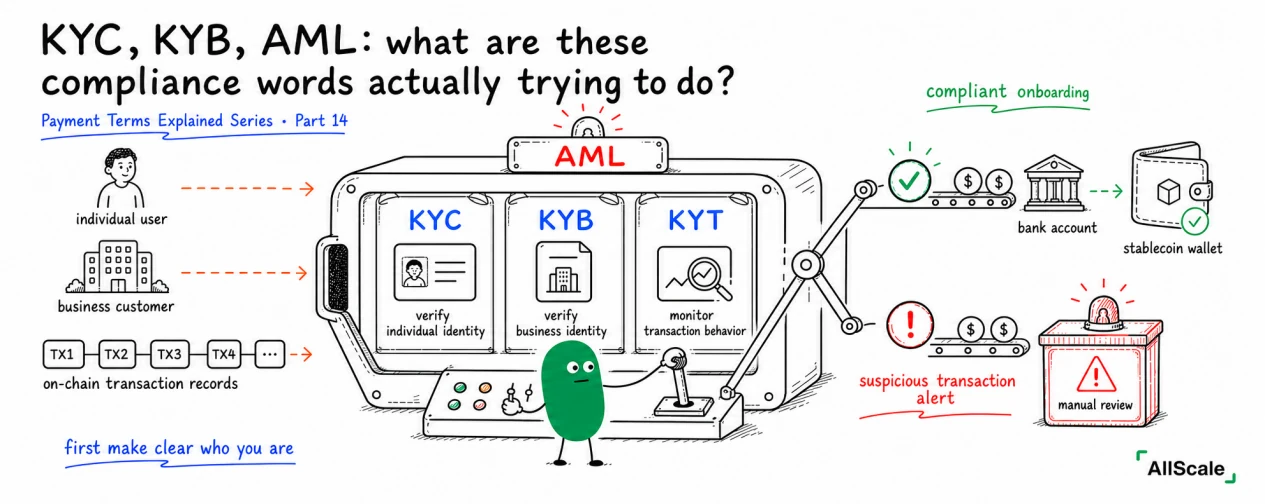
Those words are KYA, KYC, KYB, KYT, AML. In this article we'll sort them out: what each one is trying to do, why it matters, and why for a stablecoin business, compliance is actually a plus, not a minus.
1. AML: The Umbrella Goal Behind Every Compliance
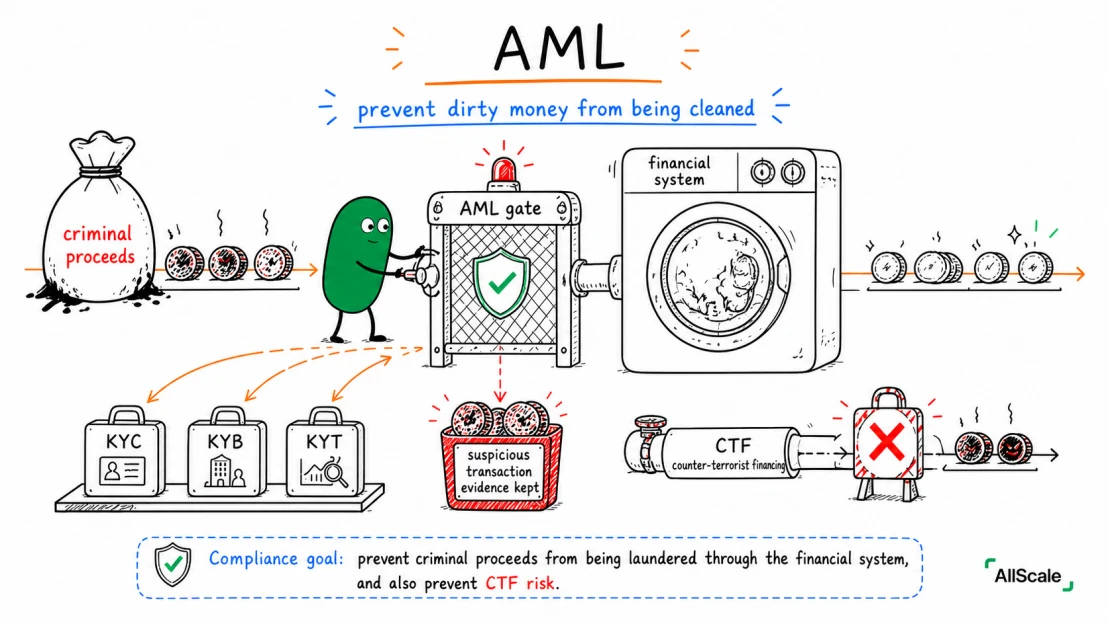
Move Start with the biggest word in compliance: AML (Anti-Money Laundering).
It's the master frame for the whole compliance stack. The goal, in one sentence: stop criminal proceeds — from drug money, fraud, bribery, and the rest — from being "washed" through the financial system into money that looks clean.
Laws in every country require financial institutions, including payment and stablecoin businesses, to shoulder AML duties.
The K-words below are all specific tactics that serve AML. Alongside AML you'll often hear CFT (Counter-Terrorist Financing), which aims to keep funds from being channeled into terrorist activity.
2. KYC and KYB: Nail Down "Who You Are" First
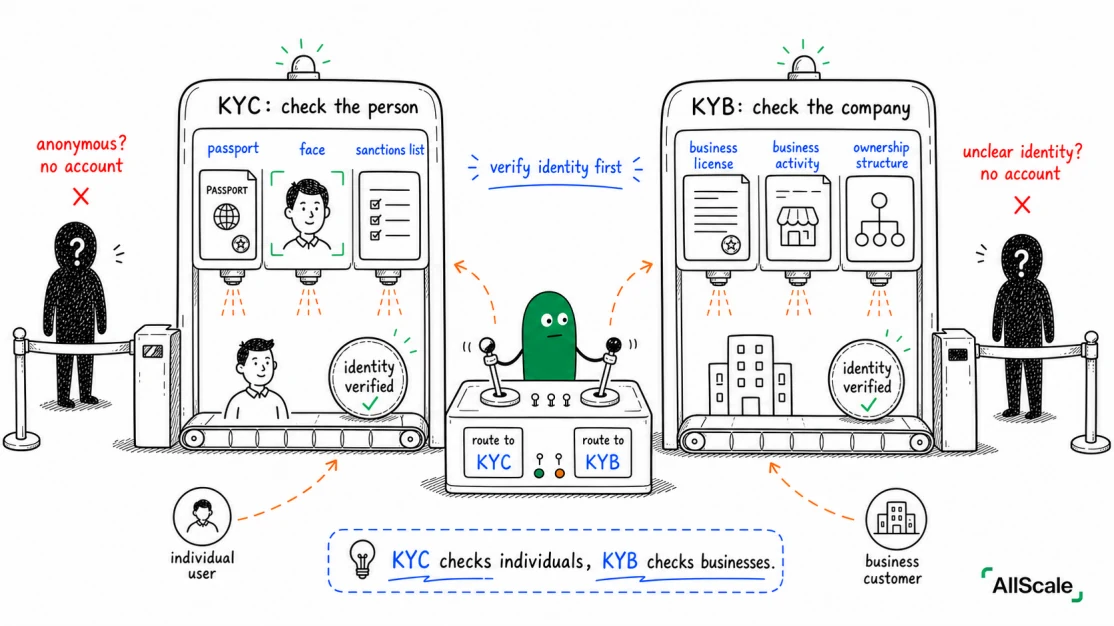
Step one in AML is not letting anonymous bad actors slip in. So identity gets verified at account opening:
- KYC (Know Your Customer): Verify the real identity of an individual customer.
Are you a real person, are you the person you claim to be, are you on any sanctions list. Handing over your ID or passport at signup and doing a face scan — that's KYC.
- KYB (Know Your Business): Same thing, but for a company. Verify the business actually exists, who the UBO (Ultimate Beneficial Owner) really is, and whether the business is legitimate.
Put simply, KYC checks individuals, KYB checks companies. Both aim to lock down identity first.
3. KYT and KYA: Watching Transactions, Screening
Addresses
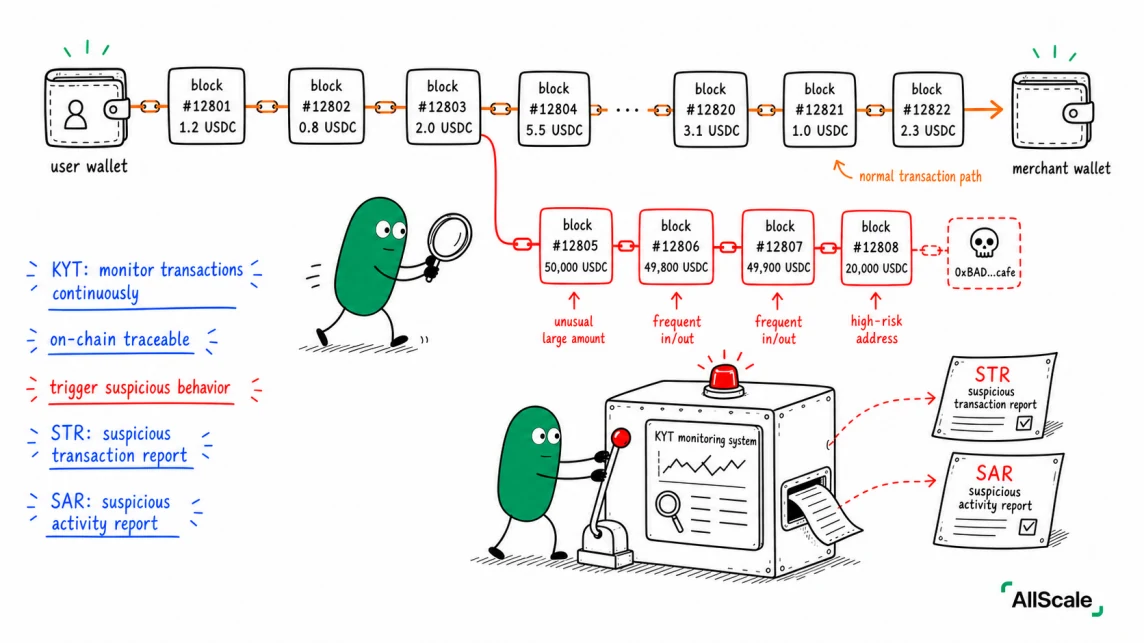
Nailing identity at signup isn't enough — bad actors can open accounts and then start misbehaving. So there's ongoing monitoring on-chain, with two tools at different levels of scrutiny:
- KYT (Know Your Transaction): Watches transactions. Real-time monitoring for anything odd — unusually large amounts, suspicious frequency of moves in and out, exposure to high-risk addresses. When something suspicious surfaces, the institution has to file a report (that's the STR / SAR, Suspicious Activity Report).
- KYA (Know Your Address): Watches addresses. Builds a risk profile for a specific wallet address — who it has moved funds with in the past, whether it's on a sanctions list, whether it's tied to mixer funds or stolen funds.
So how do these two relate? Conceptually they're two different lenses — one on transactions, one on addresses. In practice, KYT usually absorbs KYA. A mature transaction-monitoring engine, while reviewing a transaction, will also check whether the sending and receiving addresses appear on sanctions lists or look high-risk (which is exactly what KYA does), and it'll trace the funds upstream a few hops to see if the money brushed against high-risk sources indirectly.
A more accurate way to say it: KYA isn't so much a separate flow parallel to KYT as it is the "address intelligence" layer that KYT calls on when reviewing transactions. That also means platforms can dial the strictness up or down — KYA is the lighter touch, KYT the heavier one.
Worth noting: in a stablecoin, on-chain setting, KYA and KYT are actually easier to run. On-chain transactions are public and traceable, so hiding illicit funds is much harder than in the traditional cash world.
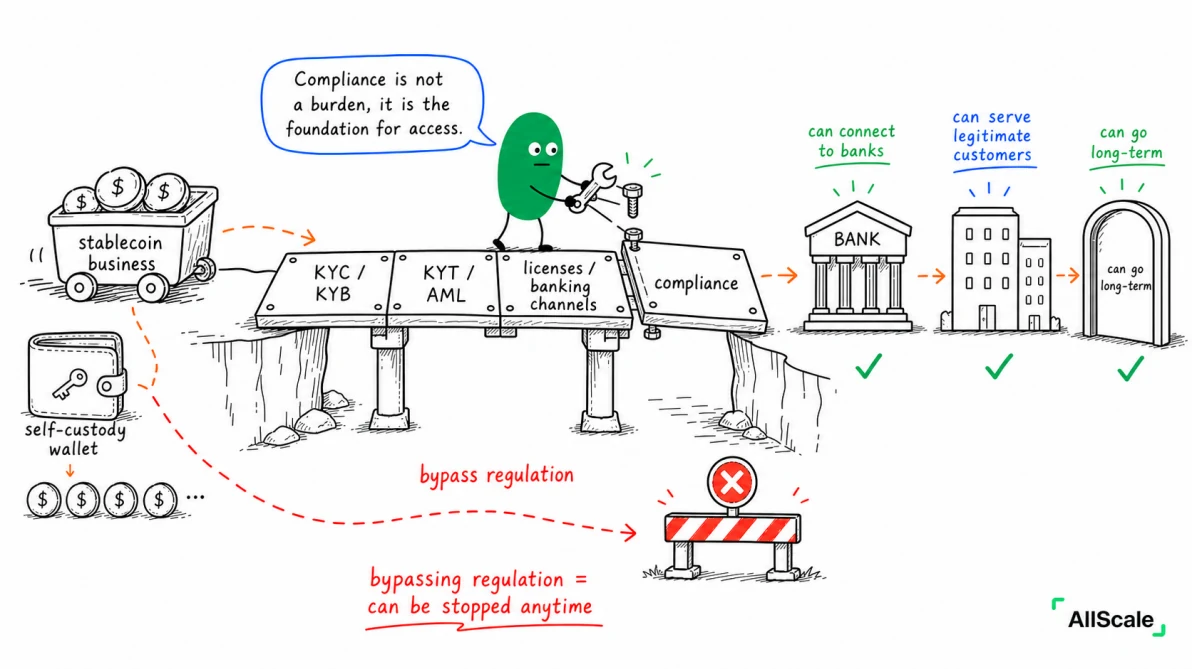
4. Why Compliance Is a Plus for a Stablecoin
Business A lot of people misread stablecoins as something used to "dodge regulation." The reality is the opposite: a stablecoin business that runs long-term, plugs into
mainstream customers and banks, and stays in the game — runs on compliance.
Three reasons. First, as noted, on-chain traceability makes KYT natural, and money laundering is harder to hide. Second, compliance is what gets a platform licensed, connected to bank rails, and able to serve legitimate businesses (global licensing gets its own article — see article 16). Third, for merchants, picking a compliant platform means your funds are safer and you're less likely to get dragged down if a counterparty blows up.
Compliance has a cost and a threshold: identity verification, reviews, record-keeping — all of it takes time and effort. What it buys, though, is longevity, and the ability to operate above board. For anyone serious about the business, it's a layer of protection, not a burden.
AllScale operates as a self-custodial stablecoin digital bank under a regulated framework. Putting compliance up front is exactly what lets merchants' cross-border collections stay both efficient and sustainable.
Recap AML (Anti-Money Laundering): The umbrella goal — keep dirty money from being washed clean. CFT (Counter-Terrorist Financing) is its twin.KYC / KYB: Identity verification at signup — KYC for individuals, KYB for companies.KYT (transaction monitoring): Ongoing watch for unusual transactions; being on-chain and traceable actually makes it easier.
In one line: Compliance isn't about dodging regulation. It's the precondition for a stablecoin business to stand up in daylight and stick around.
Next article: a compliance rule that's unique to crypto. When stablecoins move between platforms, regulators require the platforms to pass sender and receiver identity information to each other — that's the "Travel Rule," and behind it sits the VASP (Virtual Asset Service Provider).