
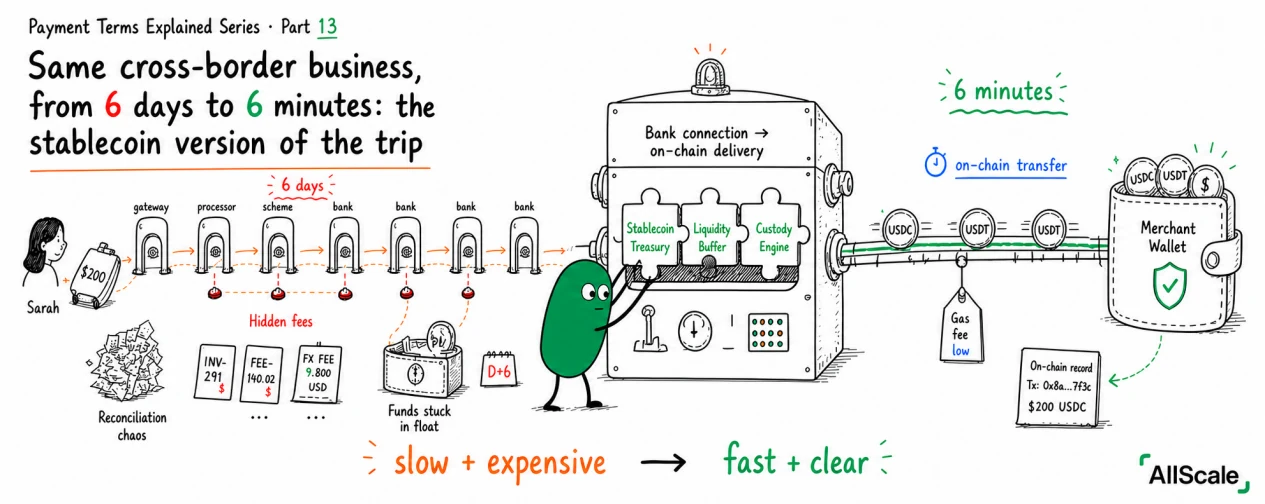
Articles 10 through 12 laid out the three pieces of the stablecoin story: the stablecoin itself, on/off-ramps, and self-custody. This article puts them together and drops them into a real business scenario, as a head-to-head with the "6 days, $12 chewed off" journey from article 7.
Disclaimer: the days and fees below are illustrative, not real data, actual numbers vary by channel.
1. Meet Lin, and his monthly cross-border headaches
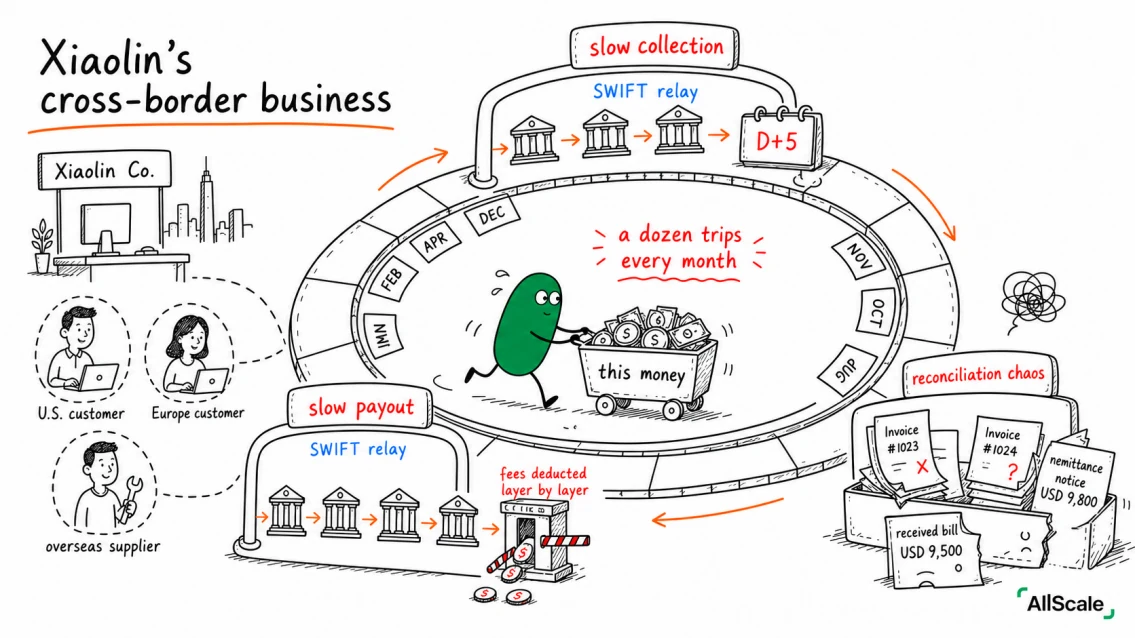
Lin runs a small cross-border services team in Shenzhen. His clients are scattered across Europe, the US, and Southeast Asia, and every month there are a dozen or so cross-border receipts. He also employs a few overseas contractors, so every month he has to pay them.
The traditional route means fighting three things every month: slow receipts (client wires take three to five days, and get nibbled at every layer), messy reconciliation (which payment matched which invoice, cross-border memos often don't line up), and slow payouts (paying overseas contractors is another round of SWIFT hops and fees). The $200 journey from article 7 happens to him a dozen-plus times a month.
2. Receiving and holding: minutes to settle, money
goes straight into his own wallet This time Lin switches to AllScale for all of the above.
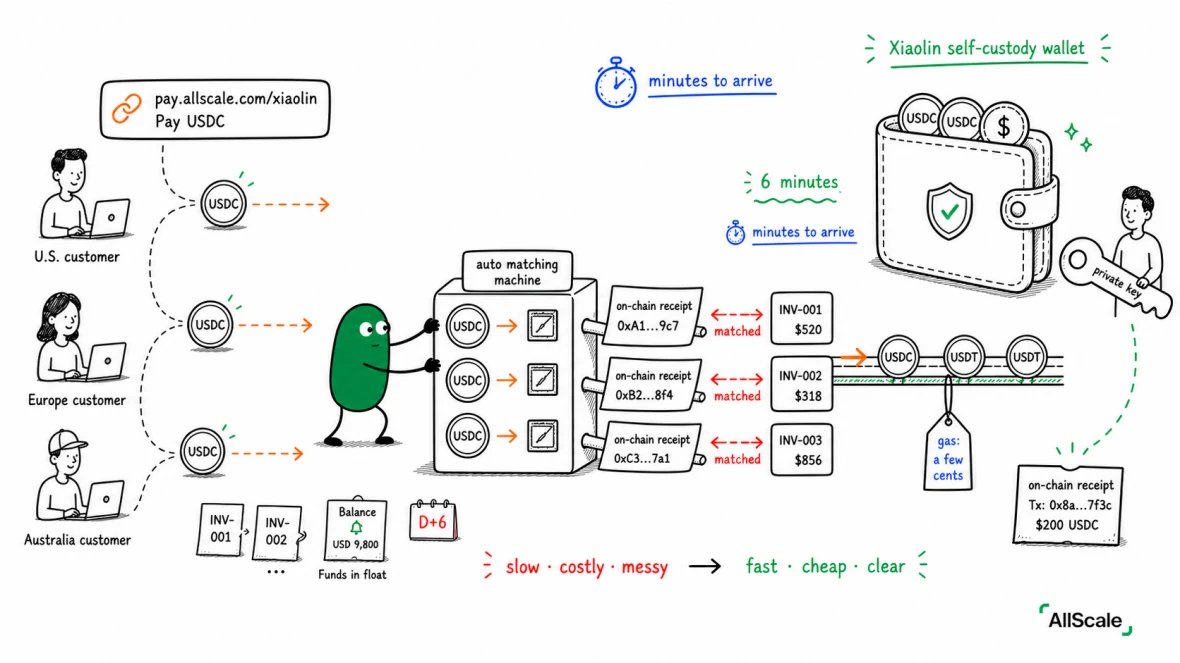
For receiving, he sends clients a stablecoin payment link (the Checkout and Invoicing flows from articles 1 and 2). The client pays in USDC, on-chain confirmation takes minutes, and the money lands straight in a wallet where Lin holds the private key, no platform account in the middle (that's self-custody from article 12).
After the money lands, two things change that he notices quickly. First, the USDC sits in his own wallet, not on a platform, so if the platform runs into trouble or a run, his money isn't in play. Second, every receipt leaves a receipt on-chain, one payment matching one invoice, so reconciliation doesn't need a human comparing rows anymore. The pain points article 2 raised about Invoicing (which payment for which invoice, missing cross-border memos) basically disappear here.
3. Paying and off-ramping: peer-to-peer payouts, fiat
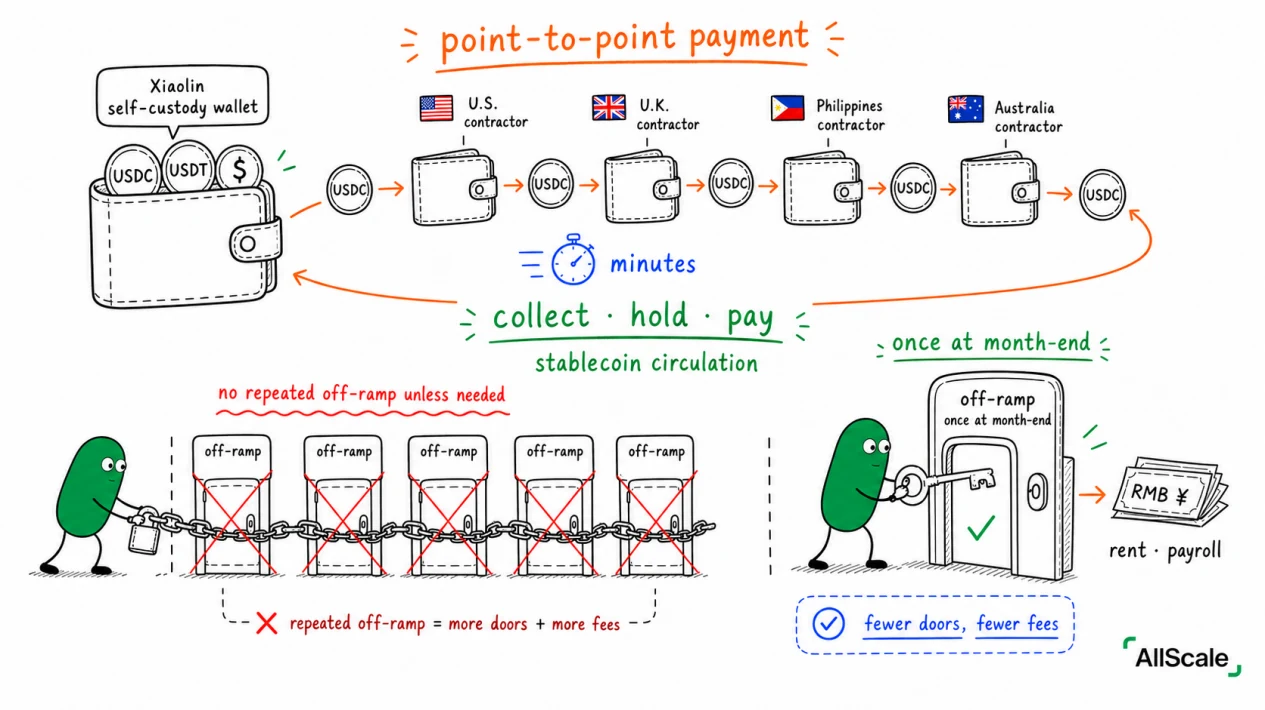
only when needed To pay overseas contractors, Lin sends stablecoins directly: peer-to-peer, settles in minutes, works the same regardless of where the contractor lives, no more SWIFTand-correspondent-bank relay from article 9.
As for "converting back to CNY," he worked out one thing: there's no need to offramp every single receipt. Day to day he keeps things flowing in stablecoins, and only at month-end when he actually needs to pay rent or salaries in fiat does he run one off-ramp (article 11). Fewer trips through the door means the unavoidable FX spread and channel fees get charged fewer times.
4. Head-to-head with the journey in article 7
For the same kind of cross-border flow, the two paths compare like this:
- Time: traditional takes three to five days or longer, stablecoin path takes minutes.
- Cost: traditional loses 3–4% per transaction across fees, FX spread, and correspondent-bank charges. Stablecoin path costs a few cents in network fees, plus a single off-ramp at the end.
- Reconciliation: traditional relies on manual matching, cross-border memos often missing. Stablecoin has every transaction on-chain, one payment matches one invoice.
- Ownership of funds: traditional funds move through platform or bank systems.
Stablecoin funds sit in a wallet Lin controls himself.
The stablecoin path has its own caveats. The on/off-ramps still need KYC (article 14 covers that). Private keys need to be kept safe (article 12). Stablecoins themselves
carry reserve and regulatory risks (article 10). It fits businesses like Lin's, doing frequent cross-border and willing to accept the trade-offs, not every use case for every person.
For Lin, the math is easy: what used to be a dozen monthly rounds of "6 days, a few percent shaved off" is now "minutes, a few cents." That's the change AllScale is trying to bring to cross-border business.
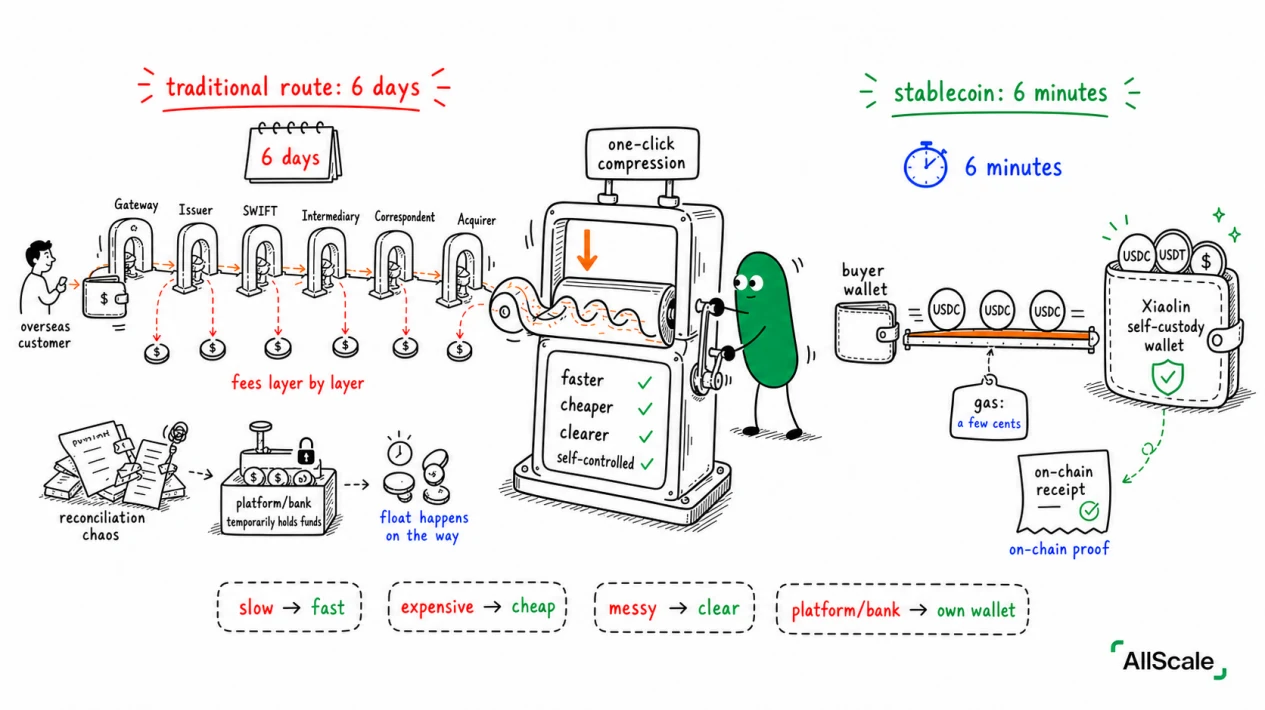
Recap Receiving: stablecoin payment link, settles in minutes, money goes into a wallet Lin controls. Holding and reconciliation: funds aren't on a platform, every transaction is on-chain, reconciliation is clean. Paying and off-ramping: peer-to-peer payouts settle in minutes, off-ramp only when fiat is actually needed.
One line: stablecoins plus self-custody turn the "slow, expensive, messy" of crossborder into "fast, cheap, clear," on the condition you accept KYC at the ramps and keep your own private keys.
Next article moves into the last big block of the series: compliance. Doing crossborder and stablecoin business means you can't dodge KYC, KYB, and AML. What are they actually about, and why? We'll start from the basics.