
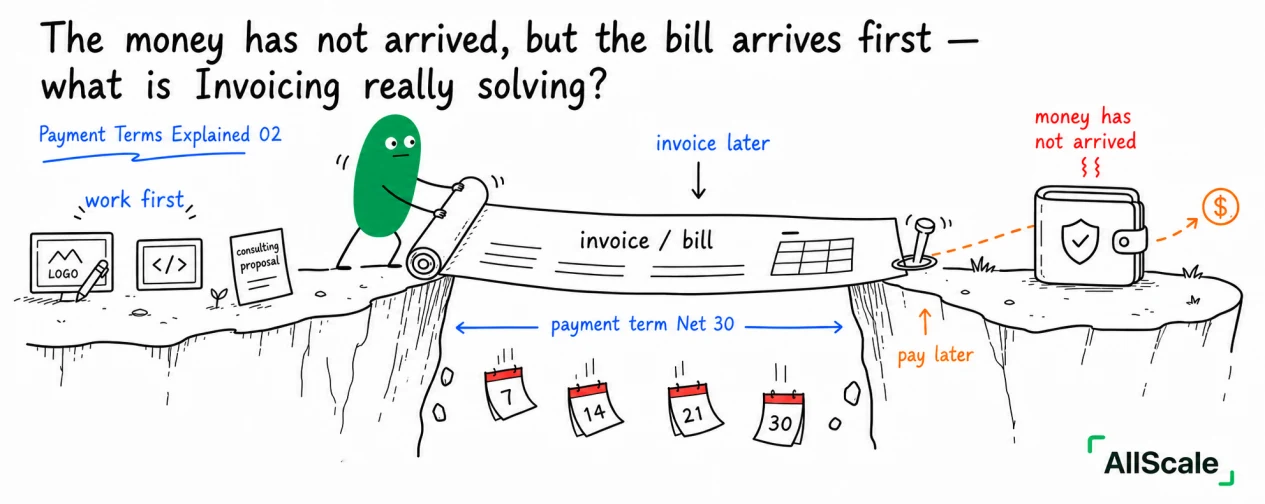
You take on a gig: design a logo, write some code, run a consulting session. Job done. How do you get paid? You're not going to ask the client for cash, so you hand them a "bill" that spells out what you did, how much it costs, and where to pay.
That bill is an Invoice, and the whole act of sending it and collecting payment is called Invoicing.
Last time we covered Checkout. This time it's Invoicing. Both are about "getting paid," but they solve two completely different kinds of business.
1. What Exactly Is an Invoice
An Invoice is a document that spells out "who, to whom, why, how much, and by when." Invoicing is the entire process of getting paid through that document.
The biggest difference between it and Checkout is timing:
Checkout = the goods are right here, you buy on the spot, you pay on the spot.
Instant transaction, cash for goods. The classic example is e-commerce.
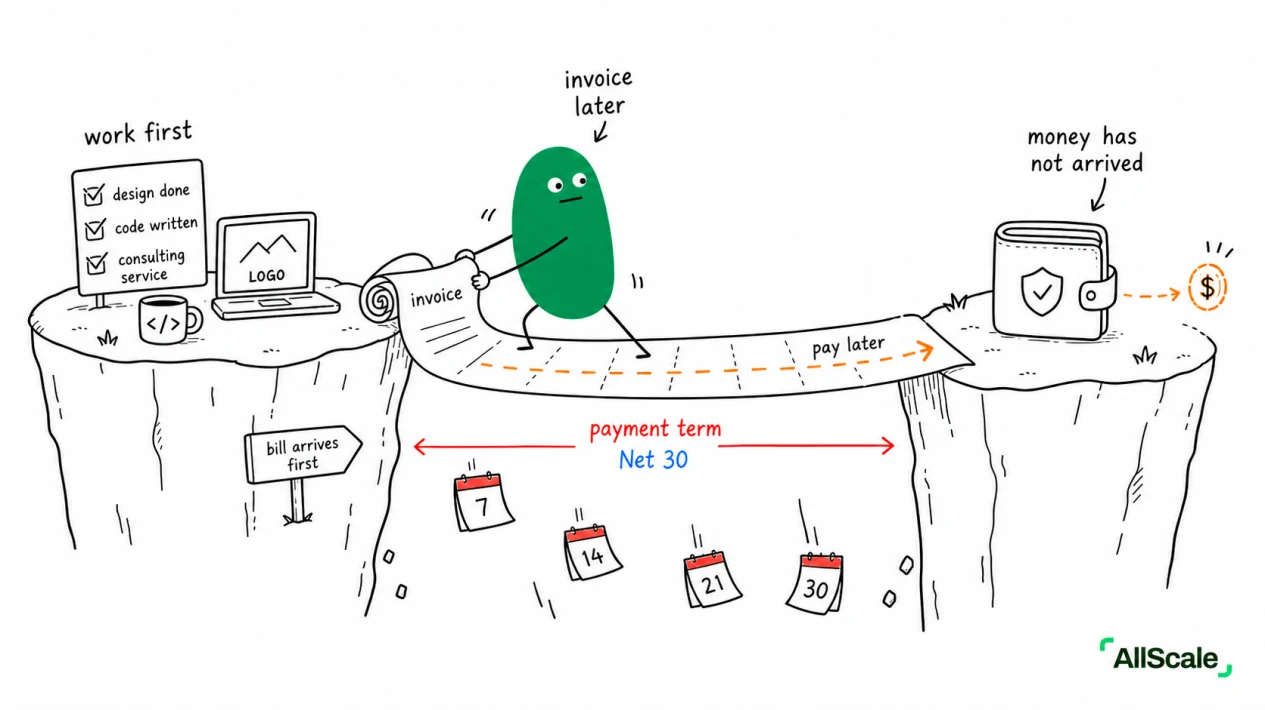
Invoicing = I do the work or ship the goods first, then hand you a bill, and you pay later. There's a payment window in between. The classic examples are freelancing, consulting, and B2B supply.
Put simply, Checkout is "pay first," Invoicing is "pay later." Almost every business's collection flow is one of these two, or some combination.
2. Who's on an Invoice
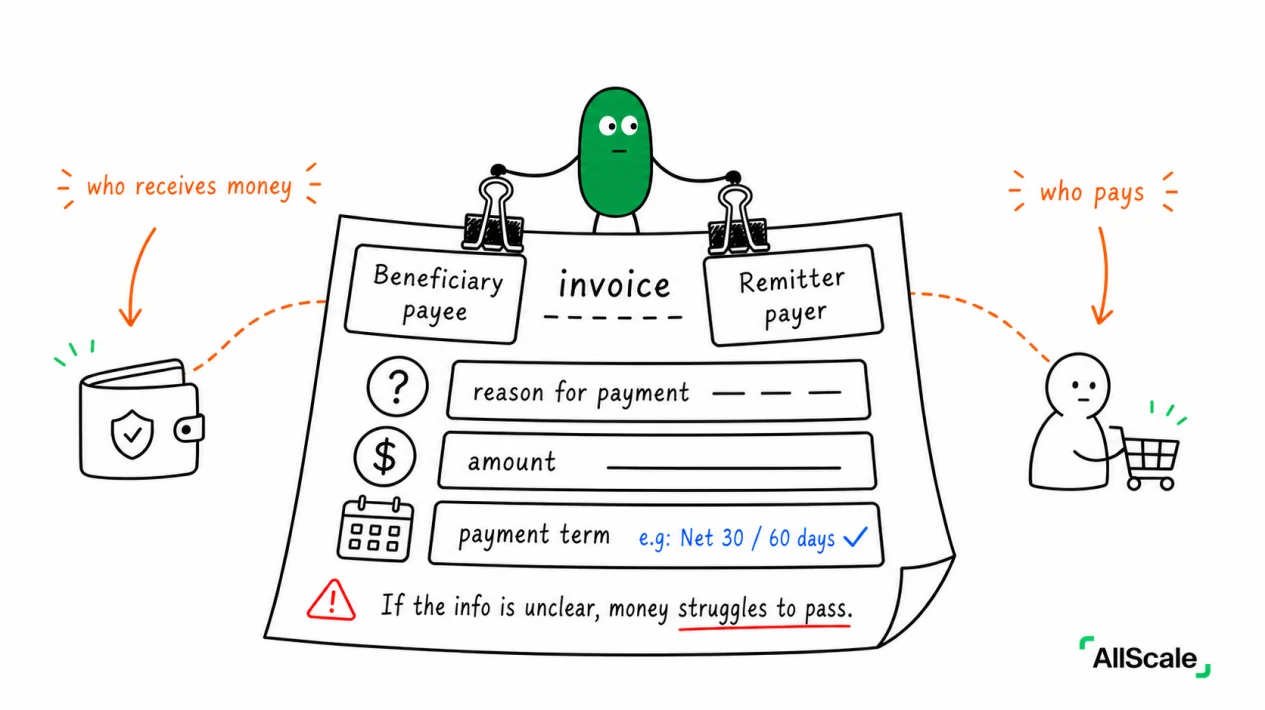
A proper invoice needs to be clear about at least three things: who's collecting, who's paying, and why. That brings in two new terms:
- Beneficiary: the party the money ultimately lands with, i.e. you, the one sending the invoice.
- Remitter: the party paying, i.e. your client.
Besides these two, the invoice needs the amount, the reason (what you did), and one item that gets overlooked — the Payment Terms. A common one is Net 30, meaning "pay within 30 days of receiving the invoice."
Why draw all these distinctions? Because with Invoicing, there's a natural gap between sending the invoice and the money landing in your account. The client might
be in another country, using another currency, paying several days later. Almost all the headaches hide in that gap.
3. The Headaches of Traditional Cross-Border
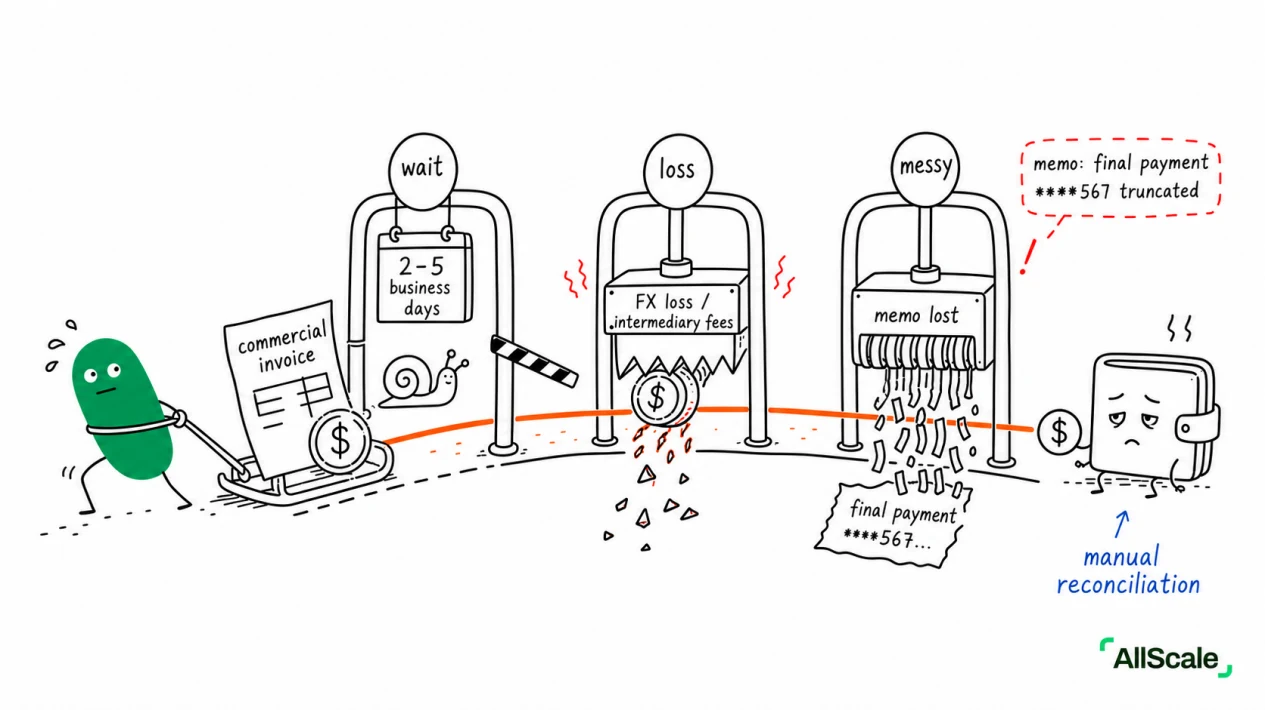
Invoicing If your client is overseas, the traditional flow usually gets stuck in three places:
- Waiting: your client pays by wire (Wire / TT), and cross-border settlement often takes 2 to 5 business days. Correspondent banks may skim a fee along the way, and reference details get lost (post #7 will break down this mechanism).
- Losses: you invoice in USD, the client pays in another currency, and the FX spread eats into the amount. A $1,000 invoice may land as a few dozen dollars short (post #8 goes deep).
- Mess: reconciliation. Which invoice does this payment match? Do the amounts line up? Cross-border transfer memos often get truncated or dropped, so finance ends up matching things by hand.
For freelancers and small teams, "chasing payments plus reconciliation" is often more exhausting than the actual work.
4. A Different Kind of Invoicing: AllScale as an
Example If you're getting paid in stablecoins (USDT, USDC), the whole process is a lot lighter.
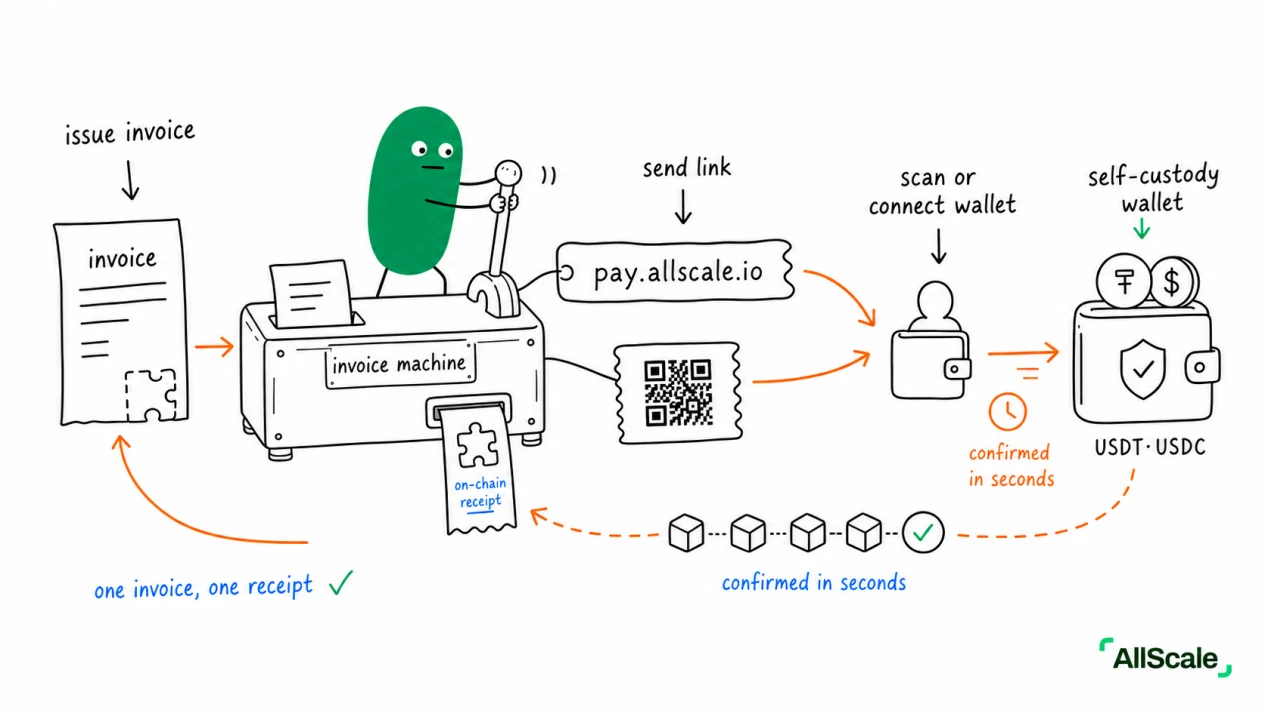
Using AllScale Invoicing as an example, the flow looks like this:
- Create the invoice: fill in the amount, the reason, the currency, and it generates an invoice and a link.
- Send it: send the link to your client — email, WeChat, Telegram, whatever works.
- Get paid: the client opens it, connects a wallet or scans a QR code, and the payment confirms on-chain in seconds.
- Settlement: the money goes straight into your self-custody wallet, no platform account acting as middleman. Reconciliation: every payment gets an on-chain receipt, one-to-one with the invoice, with the source clearly recorded.
No multi-day wire, no FX spread quietly eating your money, no manual reconciliation — invoice and receipt line up on-chain, one-to-one.
Wrap-Up
Checkout solves "buy on the spot, pay on the spot." Invoicing solves "work first, get paid later." Between them, they cover pretty much every payment scenario a business runs into.
But "getting the money" doesn't mean case closed. What if the client wants a refund?
What if they pay and then change their mind and file a dispute? Next time we'll cover Refund and Chargeback, and look at whether money that's been collected can still be taken back — and why the answer looks completely different between card payments and stablecoins.