
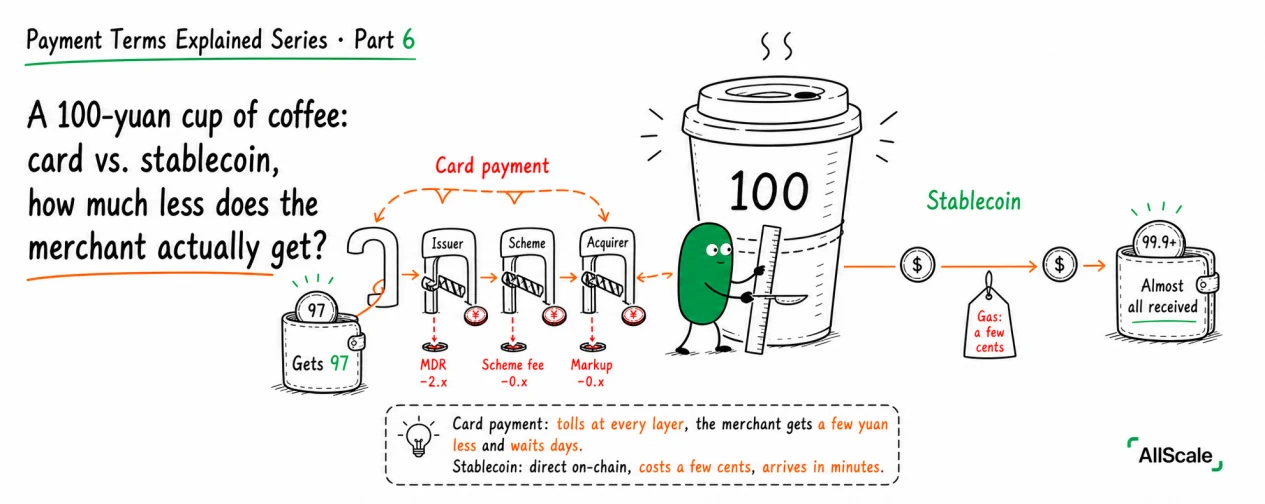
Part 4 broke down the four players behind a payment. Part 5 walked through the full lifecycle of one transaction. By now you've probably noticed: money passes through a lot of hands to reach the merchant, and every hand along the way skims a bit off the top.
Today we lay out that "toll" so you can see it: a $15 coffee, customer pays $15 by card, how much does the merchant actually keep? Where do the missing dollars go?
1. Meet the total: MDR
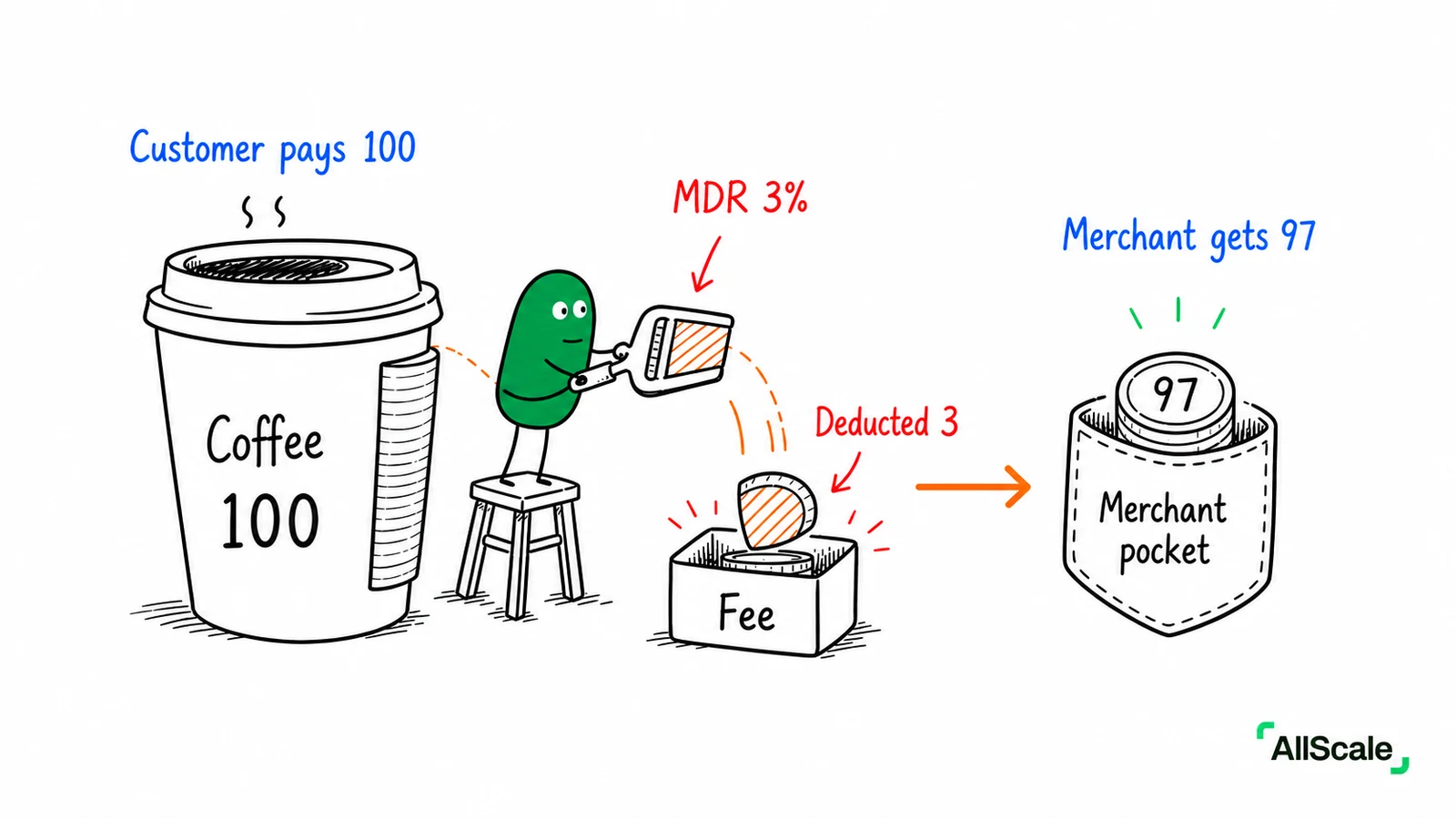
The total fee rate a merchant pays on each card payment has a name: MDR (Merchant Discount Rate).
If this coffee has an MDR of 3%, then on the $15 the customer paid, the merchant nets $14.55, and $0.45 gets deducted.
But that $0.45 doesn't go to one party. MDR is a bundled price, stuffed with three different slices that go to three different players.
2. Who gets the $0.45
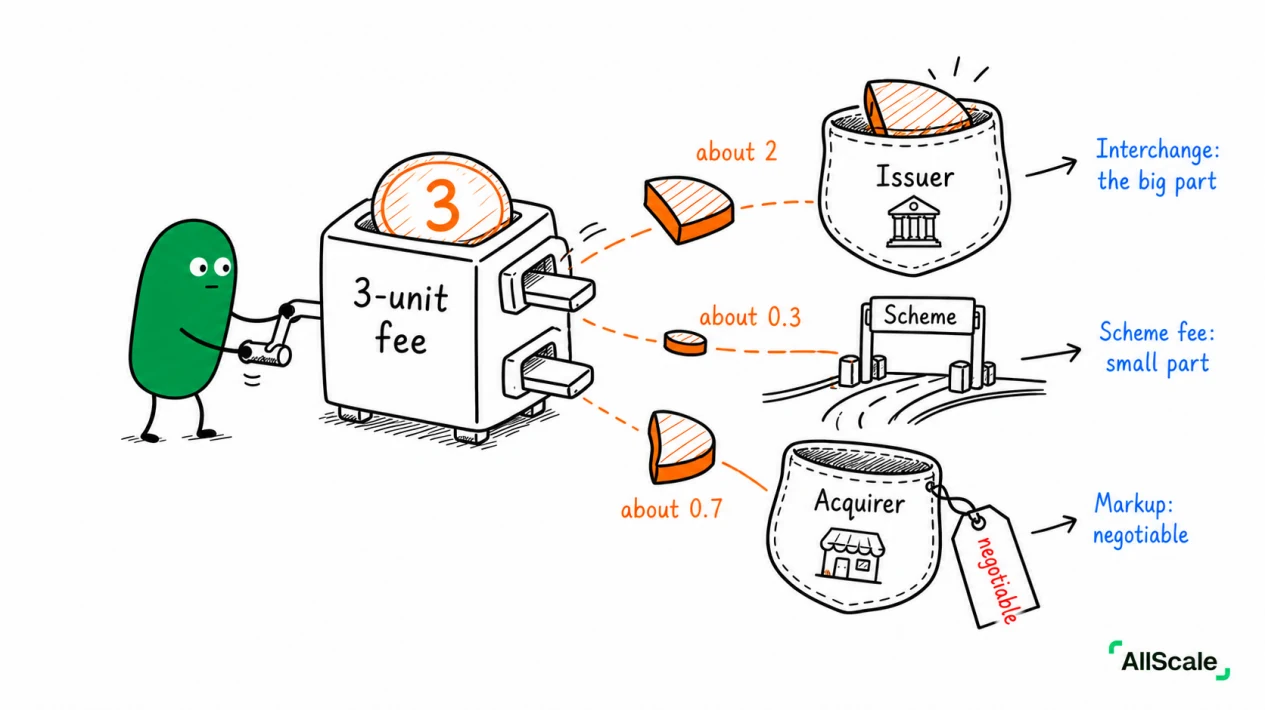
Sticking with the coffee example, here's how the $0.45 splits (exact ratios vary by card type and region, this is just illustrative):
- Interchange fee: The big slice, around $0.30. This goes to the issuing bank, the bank that issued the customer's card. It takes the largest share because it carries the credit and risk (fronting the money, fraud protection, dispute handling).
- Scheme fee: A small slice, around $0.05. This goes to card schemes like Visa and Mastercard, as a toll for using their "highway."
- Acquirer markup: The remaining $0.10 or so. This is what the acquirer or payment service provider earns, and it's the only slice that's negotiable. When you talk fees with your acquirer, this is basically what you're talking about.
One line to remember: your fee ≈ issuer (big) + card scheme (small) + acquirer (markup).
3. Two traps: opaque pricing, and cross-border
stacking Trap one: you may not see how the $0.45 splits.
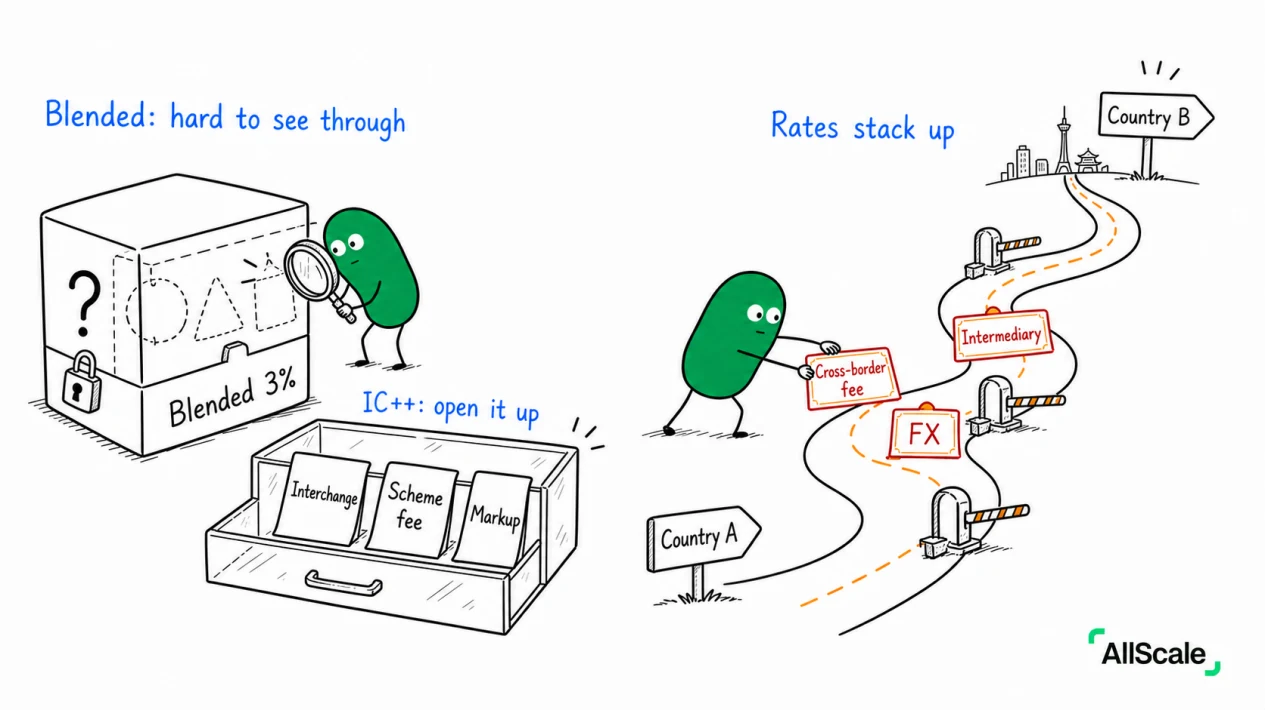
For the same 3%, there are two ways to price it:
- Blended rate: three slices bundled into one flat number, like "3% + $0.05."
Simple and easy, but you can't see the breakdown, and you can't tell how much markup the acquirer added.
- IC++ (Interchange Plus Plus): three slices itemized clearly. Interchange this much, scheme fee that much, acquirer markup this much. All spelled out.
Small merchants usually go with Blended for convenience. Large merchants prefer
IC++ so they can see the numbers and negotiate.
Trap two: cross-border stacks the rate higher.
Domestic card payments might run under 1%. Cross-border often climbs to 3–4% or more. That's because you're layering several extra costs onto the base rate: crossborder interchange is more expensive to begin with, there's a currency conversion fee (covered in Part 8), and there may be one or two extra hops in the middle, each taking a cut.
For merchants doing cross-border business, those percentage points add up to real money over a year.
4. Stablecoins: driving the toll to near zero
Back to what we do every day. Stablecoin payments don't have the issuer / scheme / acquirer stack layered on top of each other (this is the "cutting out the middleman" story from Part 4). So there's no interchange, no scheme fee.
The main cost is the on-chain gas fee (network fee), typically a few cents flat, and largely independent of the payment size.
Compare the coffee again: card payment loses $0.45; stablecoin might cost a few cents in network fees. The larger the amount, and the more cross-border you go, the wider the gap. On a $10,000 cross-border payment, card can eat $200–300; stablecoin still costs a few cents.
Card fees aren't pure waste, of course. Part of that 3% pays for the issuer's risk controls, dispute handling, and consumer protection (Part 3). Stablecoins push fees to near zero, which means those "extras" need to come from you or your platform another way. So the low-fee model fits best where you don't rely on those extras:
B2B, cross-border, businesses with clear delivery.
What AllScale does is help merchants skip this whole cascade of middlemen,
dropping cross-border collection costs from "a few percent" to "a few cents in network fees."
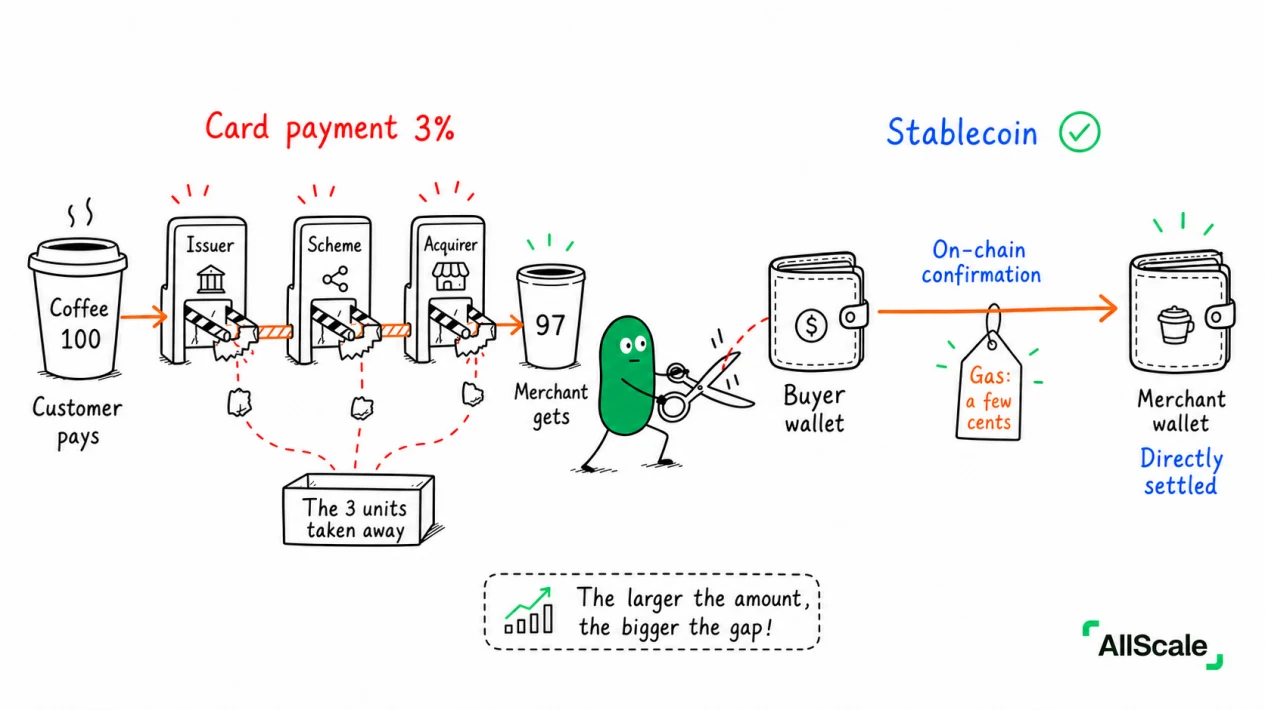
Recap MDR: the total fee rate per card payment. Interchange: the big slice, goes to the issuer. Scheme fee: small slice, goes to Visa/Mastercard. Acquirer markup: what the acquirer earns, and the only slice you can negotiate.
One line: the $0.45 skimmed from your $15 coffee mostly went to the issuer.
Stablecoins basically don't charge this toll.
Next up, a scenario piece: we thread the last three articles (four players, lifecycle, fees) into one full story. A cross-border card payment, from customer clicking "Pay" to merchant actually receiving the money. Who's involved, how many days it takes, how much gets skimmed off.