
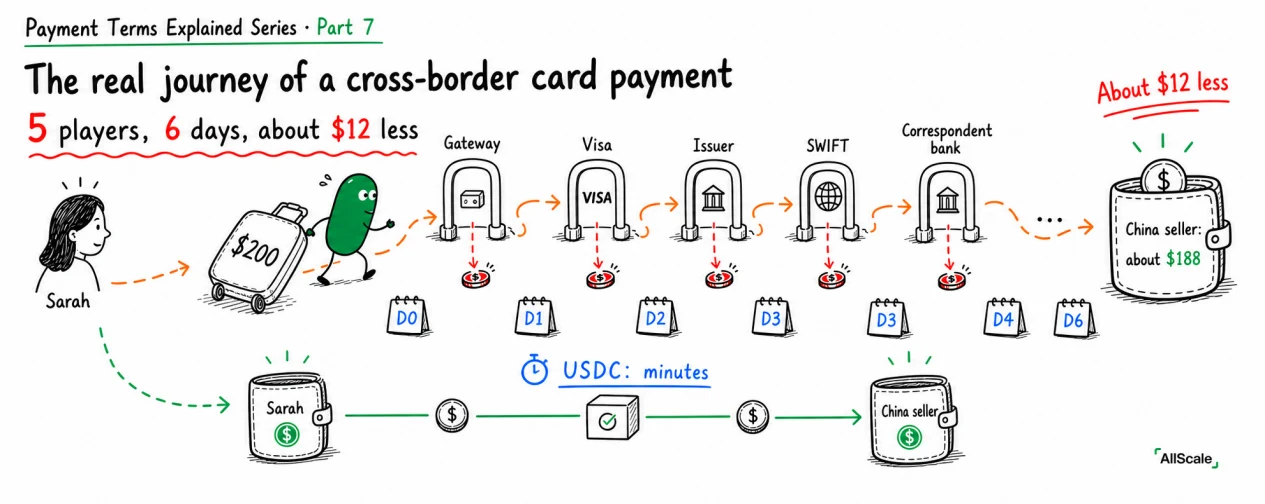
The last few articles took the machine apart piece by piece: Part 4 covered the four players, Part 5 covered the lifecycle of one transaction, Part 6 broke down the fees.
This one puts the pieces back together. We're going to follow a real cross-border payment from start to finish.
The star is one order: Sarah, an American shopper, buys a $200 dress from a Chinese seller's direct-to-consumer site with her Visa card. We're going to track this $200: where it goes, how long it takes, and how much survives to the Chinese seller.
Disclaimer: the days and fees below are rough illustrations for educational purposes.
Actual numbers vary by bank, card type, and region.
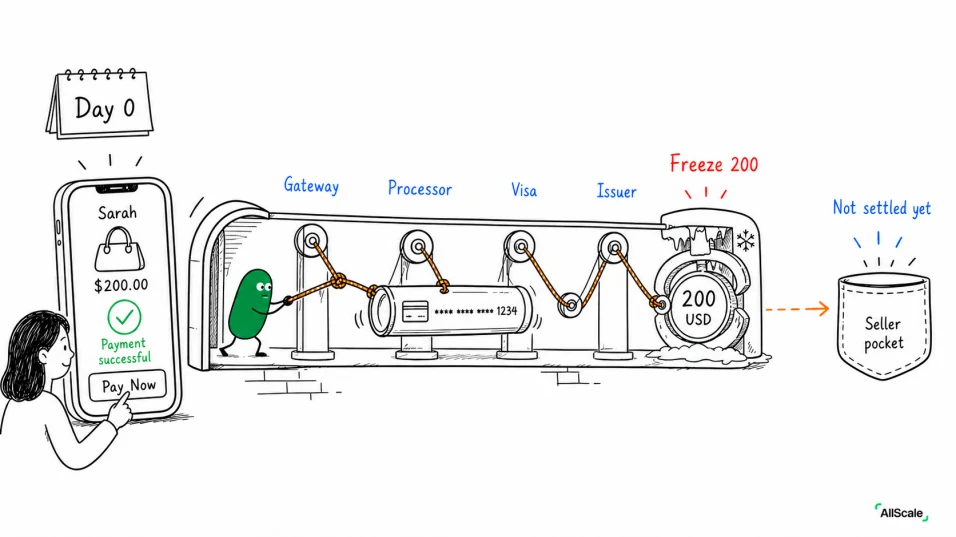
1. The few seconds after clicking "Pay" (Day 0)
Sarah clicks "Pay now." What happens in those few seconds is exactly what Parts 4 and 5 covered:
Payment gateway encrypts her card info → processor sends the authorization request → routed via Visa (card scheme) to Sarah's issuing bank (a U.S. bank) → issuer checks balance and risk, holds the $200 → auth approved, response travels back the same path in seconds.
Sarah sees "Payment successful" on her screen. But remember the key insight from Part 5: no money has actually moved yet. It's just been held. The Chinese seller has received exactly zero at this point.
2. The next few days: capture, clearing, cross-border
transit (Days 1–5)
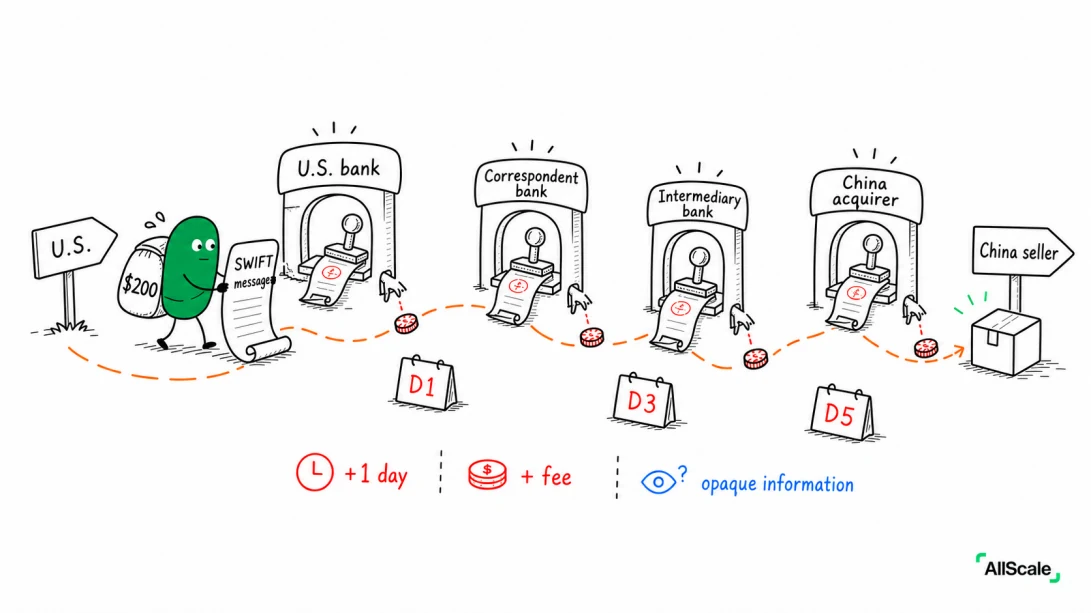
The seller ships the goods and formally submits a Capture. Only now does the $200 hold on Sarah's card turn into a real debit. Next comes Clearing, where Visa reconciles the transaction between the issuing bank and the acquiring bank.
The real headache is the final step, Settlement, especially the "cross-border" part.
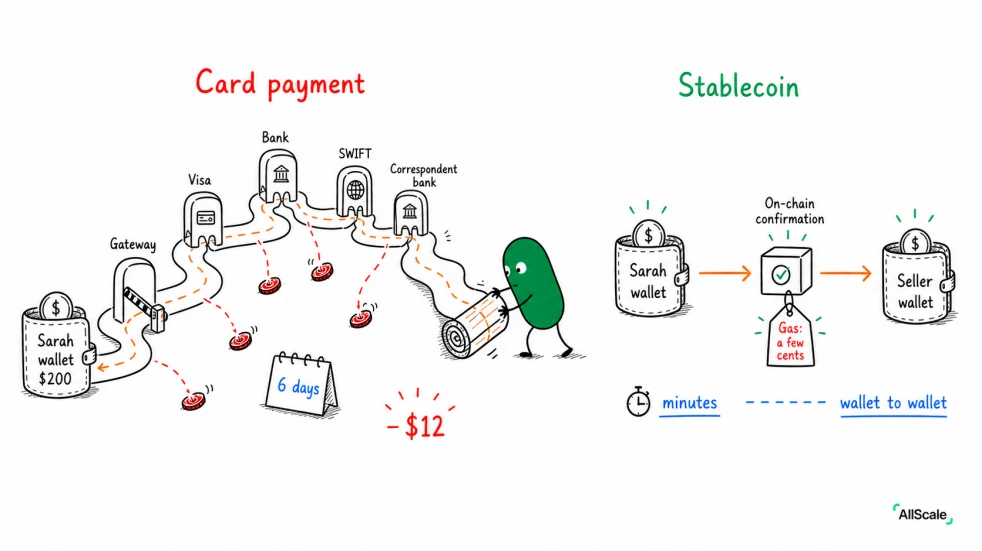
The money needs to get from the U.S. to the Chinese seller's account. In the traditional banking system, the path usually looks like this:
- Money first clears between banks on the U.S. side, then SWIFT (the global interbank messaging system, covered in Part 9) sends the cross-border instructions;
- U.S. and Chinese banks mostly don't hold direct accounts with each other, so the payment routes through a third bank both sides trust. This is called a correspondent bank;
- If there's no shared correspondent, you add an intermediary bank to relay the payment.
Every extra hop adds a day or two, another fee, and possibly another FX markup on currency conversion. There's no central dispatcher on this route. It's a relay race between banks, which makes it slow and opaque. Where exactly is the money right now? Often nobody can say.
3. Arrival: what the seller actually receives (around
Day 6)
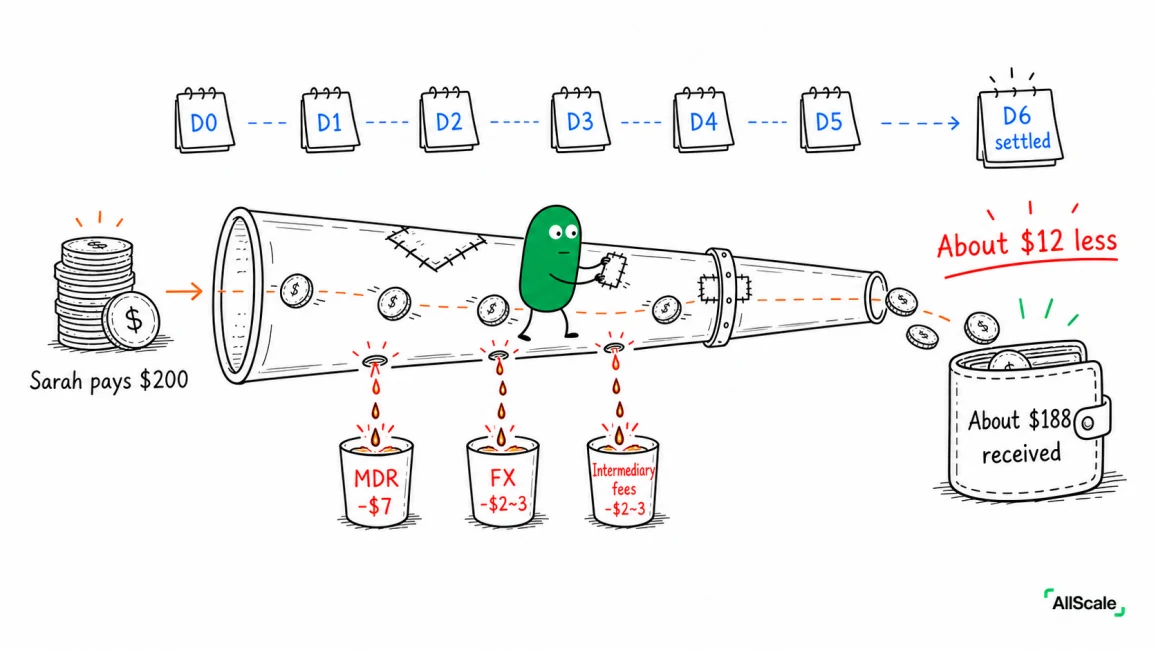
About 6 business days later, the money finally lands in the Chinese seller's account.
Rough math on how much got peeled off the $200 along the way:
- MDR fee: cross-border rate at 3.5%, roughly $7 deducted (Part 6);
- FX spread on currency conversion: USD to RMB gets shaved once, roughly $2–3 (covered in Part 8);
- Intermediary / wire transfer fees: the one or two hops in the middle skim a few more dollars.
Add it all up and the seller ends up with around $188, after waiting nearly a week.
On a small $200 order, the pipeline alone costs 5–6%. Scale that up to a $10,000 order and the erosion gets ugly.
4. What the same trip looks like with stablecoins
Back to what we do every day. If Sarah paid the $200 with USDC (a stablecoin):
Her wallet sends → on-chain confirmation (seconds to minutes) → Chinese seller's wallet receives.
No issuer, scheme, or acquirer relay. No SWIFT. No correspondent or intermediary banks. No T+ several days of settlement waiting. The seller receives around $199.9 (minus a few cents in on-chain network fees), and it's usable immediately.
Same $200: traditional path lost about $12 and took 6 days. Stablecoin path lost a few cents and took a few minutes.
To be fair, the fees layered into the traditional cross-border path pay for bank risk controls, dispute handling, and consumer protection (Part 3). Stablecoins push cost and time to a minimum, and the tradeoff is that both parties or the platform need to cover those protections themselves. That makes stablecoins a good fit for B2B, cross-border, and businesses with clear delivery, which is exactly what Sarah's order looks like.
What AllScale does is turn this "6 days, 5 players, $12 lost" trip into "a few minutes, peer to peer, a few cents."
Recap
- A cross-border card payment goes through authorization, capture, clearing, and settlement. Cross-border settlement adds SWIFT, correspondent banks, and intermediary banks in a relay.
- It's slow because there's no central dispatcher, just banks handing off one after another. It's expensive because every hop charges a fee, on top of the MDR and FX spread.
Next up, we zoom in on the most hidden fee in this whole trip: the FX spread on currency conversion. The rate on the board says one thing, but after the exchange you always feel short. We'll unpack the mid-market rate and the spread to show you this "invisible fee."