
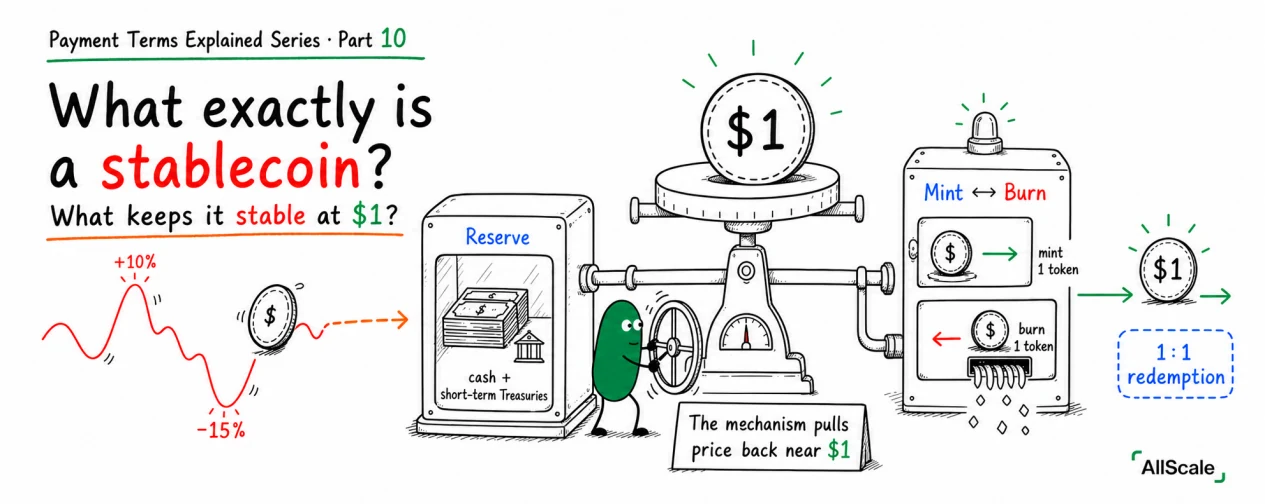
The first nine articles kept circling back to the same headaches in traditional payments: slow, expensive, and roundabout. And every time we talked about how to fix them, stablecoins showed up. This article answers the two questions head-on: what is a stablecoin, and how does it stay "stable"?
1. What a stablecoin is: a "stabilizer" bolted onto
crypto Crypto had one big problem from day one: the prices moved too much. Bitcoin up 10% today, down 15% tomorrow was routine. That makes it hard to use as money.
Nobody wants to pay salaries or settle invoices in something that might shrink overnight.
Stablecoins were built to fix that. At heart they're still crypto, but the price is pegged to a stable asset, usually the US dollar, so that 1 stablecoin stays roughly equal to $1 no matter what the market does.
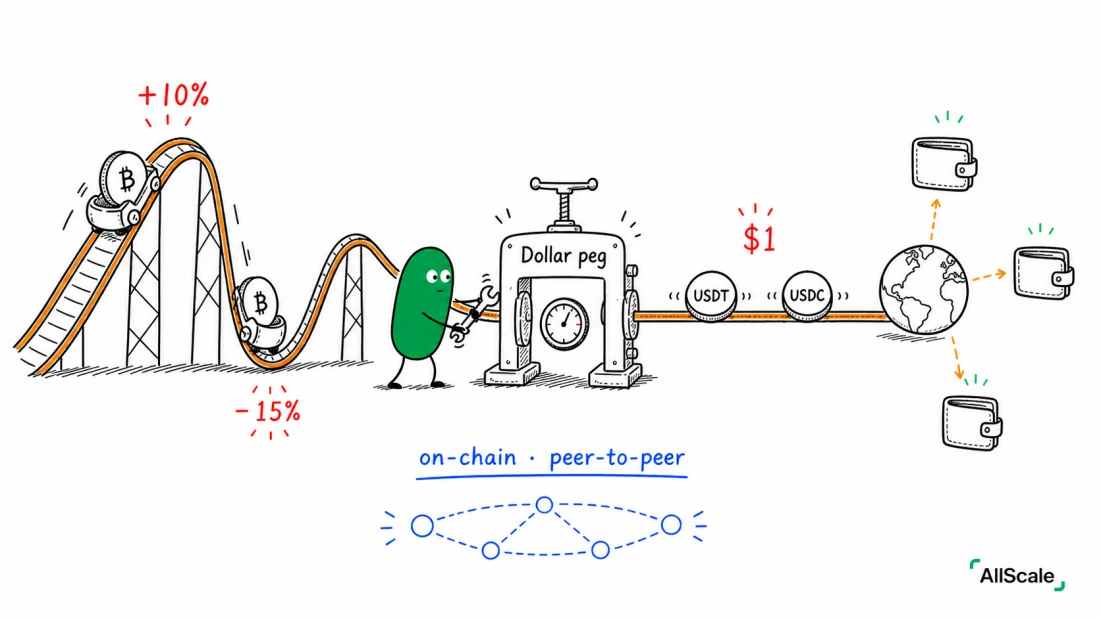
The ones you hear about most, USDT (Tether) and USDC (Circle), fall in this camp.
They keep the good parts of crypto (on-chain, peer-to-peer, global, settles in minutes) and add the stability of fiat. The "cross-border settlement in stablecoins" idea from earlier articles only works because of this "stable" part.
2. How it stays stable: reserves, plus mint and burn
The most common type (fiat-backed stablecoins) works on a very plain logic: for every stablecoin issued, the issuer holds $1 in reserves (cash, or highly liquid assets like short-term US Treasuries).
That in-and-out flow runs on two actions:
- Mint: Someone hands the issuer $1, and the issuer mints 1 new stablecoin to give back, while adding the $1 to reserves. Result: 1 more stablecoin in circulation, $1 more in reserves.
- Burn: Someone brings 1 stablecoin back to redeem it, the issuer returns $1, and burns that coin (permanently removed, no longer in circulation). Result: 1 fewer stablecoin, $1 less in reserves.
In theory then, the number of stablecoins in circulation always matches the dollars in reserve. Every coin has $1 sitting behind it.
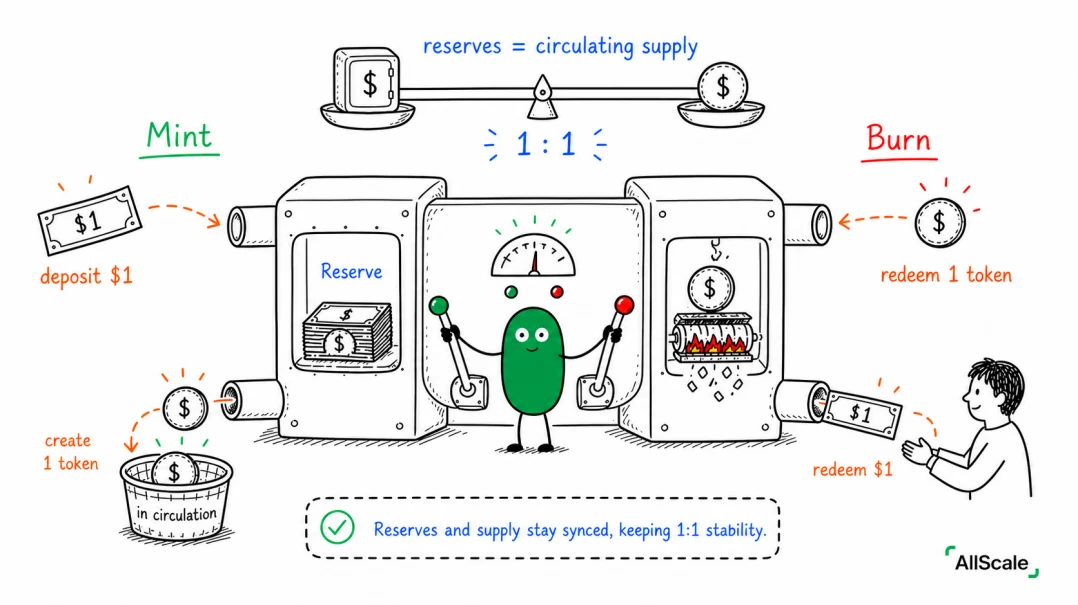
That's also why the price stays near $1: you can redeem 1-for-1 anytime. If the market price drifts, say down to $0.98, someone buys cheap and redeems at $1 to pocket the spread. That arbitrage pushes the price back to $1. That pull-back force is where the peg gets its strength.
3. But not every stablecoin is equally stable
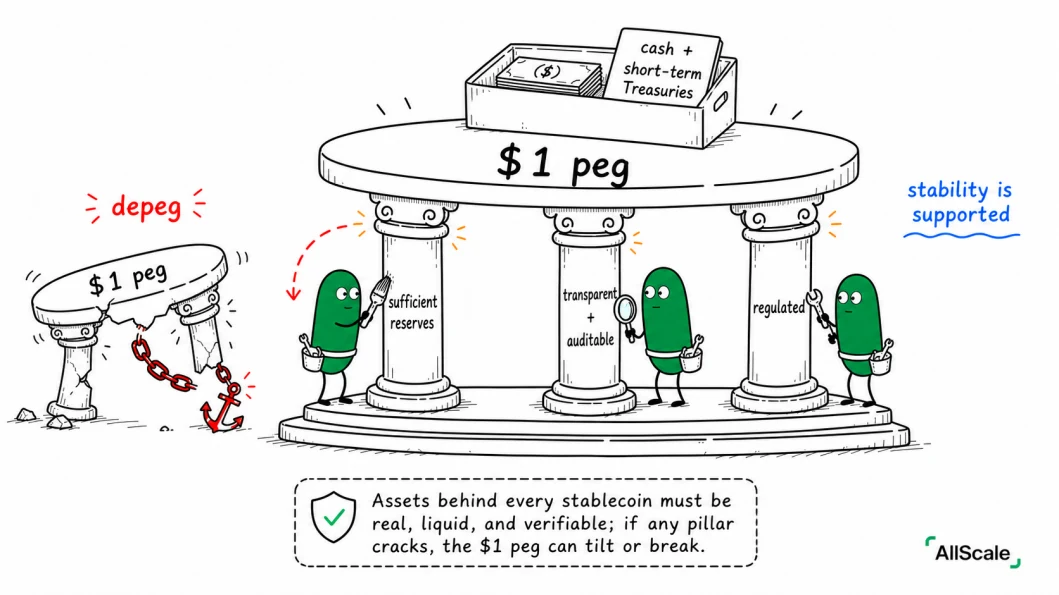
The other side of the story matters just as much: the "stable" part isn't automatic.
It only holds if the $1 behind each coin is really there, and can actually be redeemed on demand.
If the reserves aren't transparent, or the issuer misuses them, or parks them in risky
assets, the peg can break. It has happened before: in 2022, an algorithmic stablecoin called UST (backed by algorithms, not real reserves) collapsed to zero. In 2023, USDC briefly slipped below $1 when Silicon Valley Bank, one of its reserve banks, ran into trouble.
So when picking a stablecoin, three things actually matter: are the reserves sufficient, are they transparent and auditable, and is the issuer regulated.
USDT and USDC became market leaders on the strength of relatively transparent reserves and compliance backing.
4. So how do you actually use a stablecoin
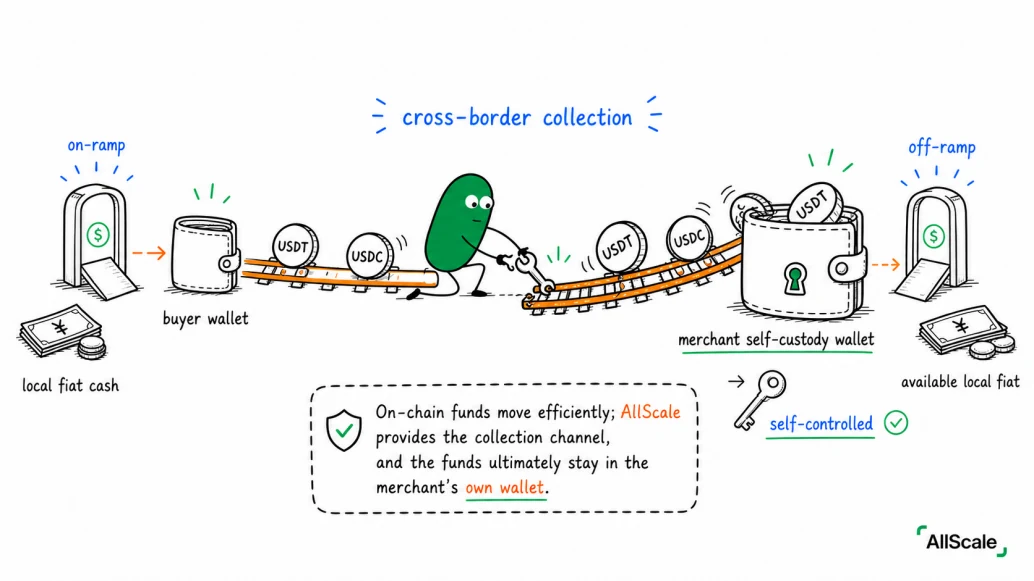
Stablecoins solve the "stable value" part. But putting them to work in a business needs two more steps: how you turn your fiat into stablecoins and back into spendable money (that's the next article, on-ramp and off-ramp), and where the stablecoins live and who holds them (article 12, self-custody).
That's where AllScale fits in: merchants can send and receive cross-border payments in mainstream stablecoins, while the coins stay in a wallet the merchant controls. You get the stability and speed of stablecoins without handing your assets to a platform.
Recap Stablecoin: a crypto asset pegged to fiat (usually USD), aiming for 1 coin ≈ $1, combining crypto's efficiency with fiat's stability. Mint: deposit $1, create 1 coin. Burn: redeem $1, destroy 1 coin. Circulation always matches reserves. What decides whether it stays stable: whether the reserves are sufficient, transparent, and regulated. Stability is engineered, not automatic.
Next article covers the door between the crypto world and the real one: how do you turn fiat into stablecoins, and stablecoins back into fiat? That's on-ramp and off-ramp.