
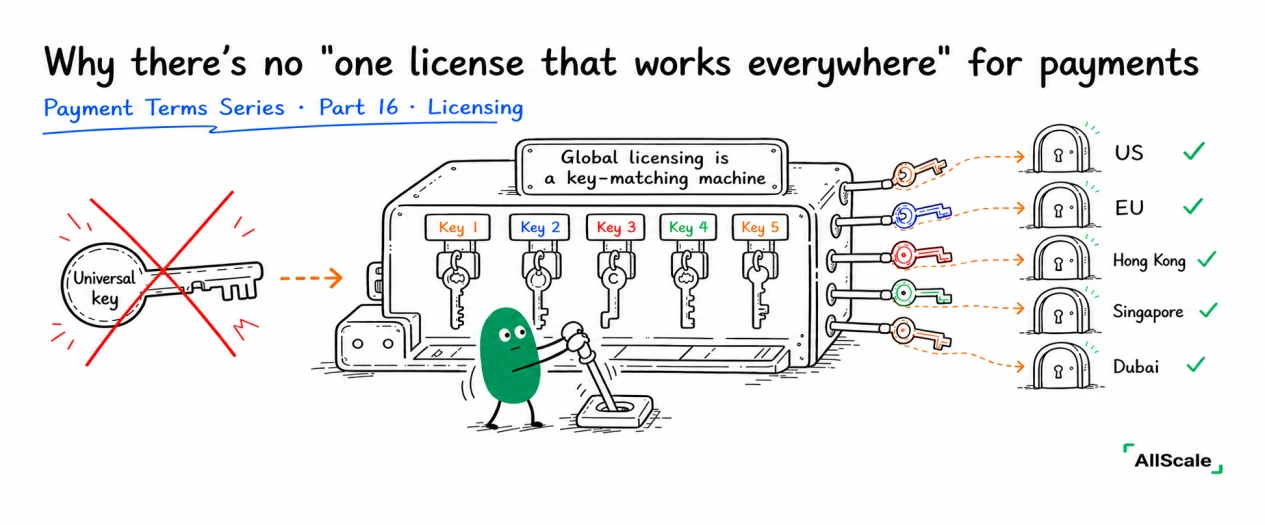
This is the last article in the series. Over the past fifteen, we've covered how money gets collected and paid, why traditional cross-border is slow and expensive, how stablecoins speed things up and cut costs, and what compliance is trying to do. This piece answers the last question: to run a global business, which "passports" do you actually need? We'll lay out the licenses in the major regions as a map.
1. First, Remember One Guiding Rule: Licenses Are
Territorial In payments and stablecoins, there's no single license that works everywhere.
Every country and region issues its own and does its own supervision. Wherever you want to collect and pay, wherever you want to serve customers, you need that jurisdiction's "passport."
That's why any global payments company you look at is really a long stack of "multijurisdiction licenses" — not one universal cert. Below we'll focus on five major markets.
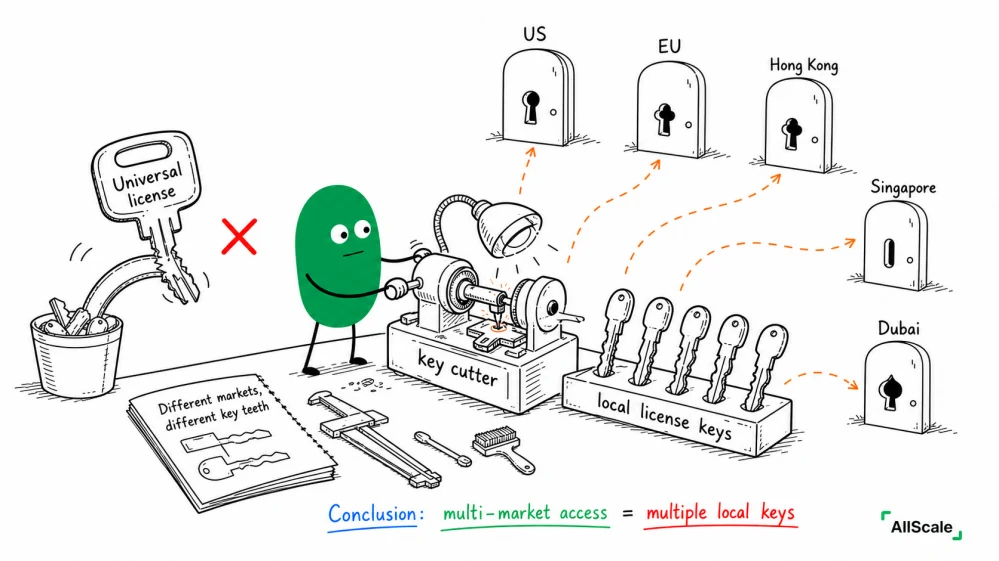
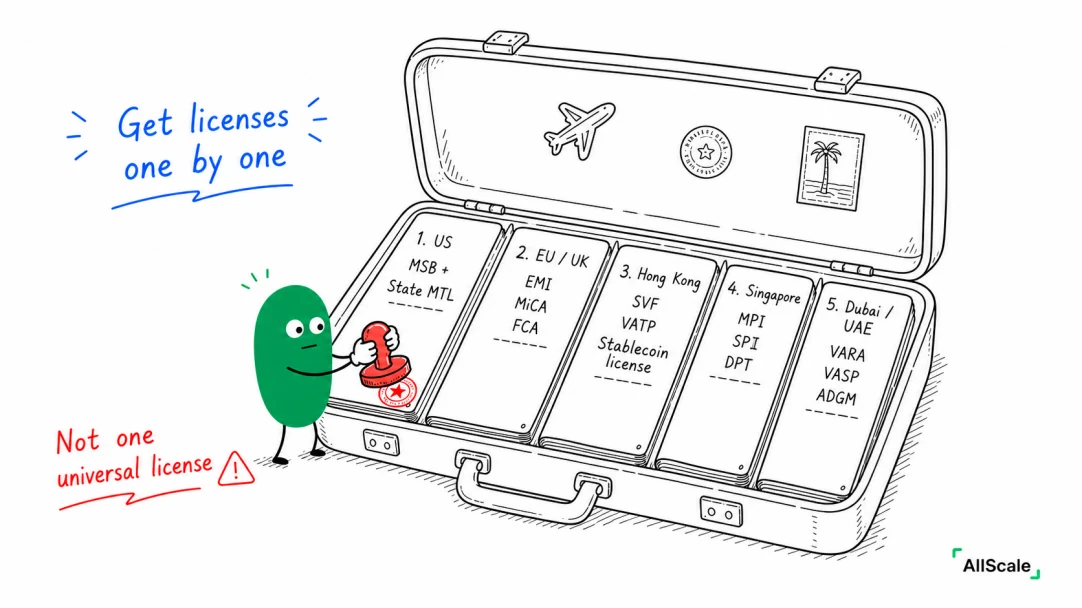
2. The "Passports" of Five Major Markets
- US: Most Fragmented, Also Most Expensive At the federal level, to do a money business you first have to register with FinCEN as an MSB (Money Services Business) — but registration isn't a license. To actually move money, you have to apply state by state for an MTL (Money Transmitter License). Forty-eight states plus Washington DC, one at a time. High cost, long timelines.
On stablecoins, the US passed its first federal stablecoin act in 2025 (the GENIUS Act), setting up a unified federal framework for stablecoin issuance for the first time.
- Europe / UK: Relatively Unified The EU has two license types: EMI (Electronic Money Institution) and PI (Payment Institution). The key advantage is the "passporting" mechanism — get licensed in one member state and you can operate across the entire EU.
For crypto, under the MiCA (Markets in Crypto-Assets Regulation) framework that took effect in 2024, what gets issued is the CASP (Crypto-Asset Service Provider) license.
The UK went its own way after Brexit — crypto businesses have to register with the FCA (Financial Conduct Authority).
- Hong Kong: The Most Watched For stored-value payments there's the SVF (Stored Value Facility) license, and virtual asset trading platforms need the VATP (Virtual Asset Trading Platform) license from the SFC (Securities and Futures Commission).
The newest, most closely watched piece is Hong Kong's stablecoin licensing regime:
Hong Kong's Stablecoins Ordinance took effect in August 2025, and in April 2026 the HKMA (Hong Kong Monetary Authority) issued its first batch of stablecoin issuer licenses. The recipients were HSBC, plus Anchorpoint — a joint venture from Standard Chartered, HKT, and Animoca. The bar to get licensed is extremely high, with regulatory requirements essentially in line with traditional banking.
- Singapore: Cleanly Tiered Under the PSA (Payment Services Act), licenses are issued in two tiers by business scale: MPI (Major Payment Institution) and SPI (Standard Payment Institution).
Crypto-related business falls under the DPT (Digital Payment Token) service category inside that framework.
- Dubai / UAE: Purpose-Built for Crypto Dubai set up VARA (Virtual Assets Regulatory Authority) specifically, issuing VASP (Virtual Asset Service Provider) licenses. Abu Dhabi's ADGM (Abu Dhabi Global Market) runs a separate financial licensing regime.
3. What This Means for a Stablecoin Business
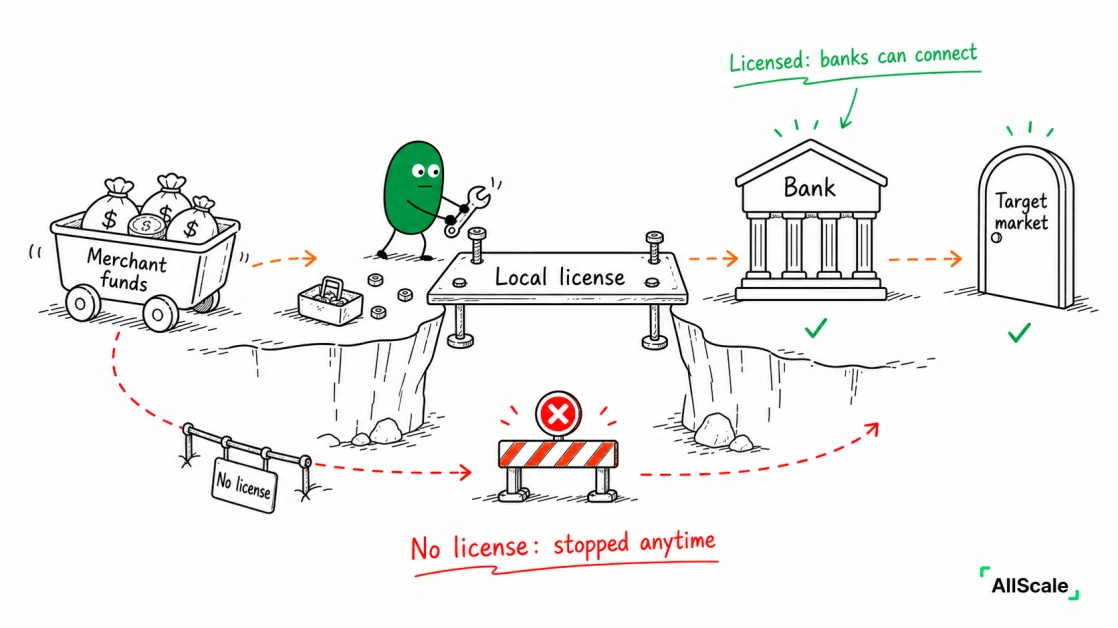
Licenses aren't wall decoration. They directly determine which markets you can legally serve and whether you can connect to local banks. How many places a platform holds licenses in basically defines the map it can cover.
For merchants, when picking a platform, you need to check whether it has the right credentials in your target markets. That's directly tied to whether your money moves in and out of that region smoothly. A platform with no license in the country you're doing business in — no matter how fast or cheap it is — can be shut down by local regulators at any time.
That's why the compliance topics from the last two articles (14 and 15) and the licensing map in this one, taken together, are the bedrock for whether a stablecoin business can "go global and last."
AllScale, as a self-custodial stablecoin digital bank, is building out the right credentials under a regulated framework — the point being to let merchants' crossborder collections legally and reliably cover more markets.
4. Sixteen Articles In, We've Actually Walked the Full
Path of One Payment Looking back: we started with the Checkout that users tap every day (article 1), moved through invoicing, refunds, the four actors behind the scenes, the lifecycle of a single transaction, and the fees taken at every hop — enough to see why traditional payments are slow, expensive, and roundabout. Then we walked into stablecoins, on/off-ramps, and self-custody, and saw a faster, cheaper path. Finally, through compliance and licensing, we saw how that path can hold up and stand up to daylight.
The essence of payments hasn't really changed: move money safely and accurately from one party to another. What's changed is that we finally have a more efficient way to do this oldest of jobs.
That's what AllScale is trying to do.
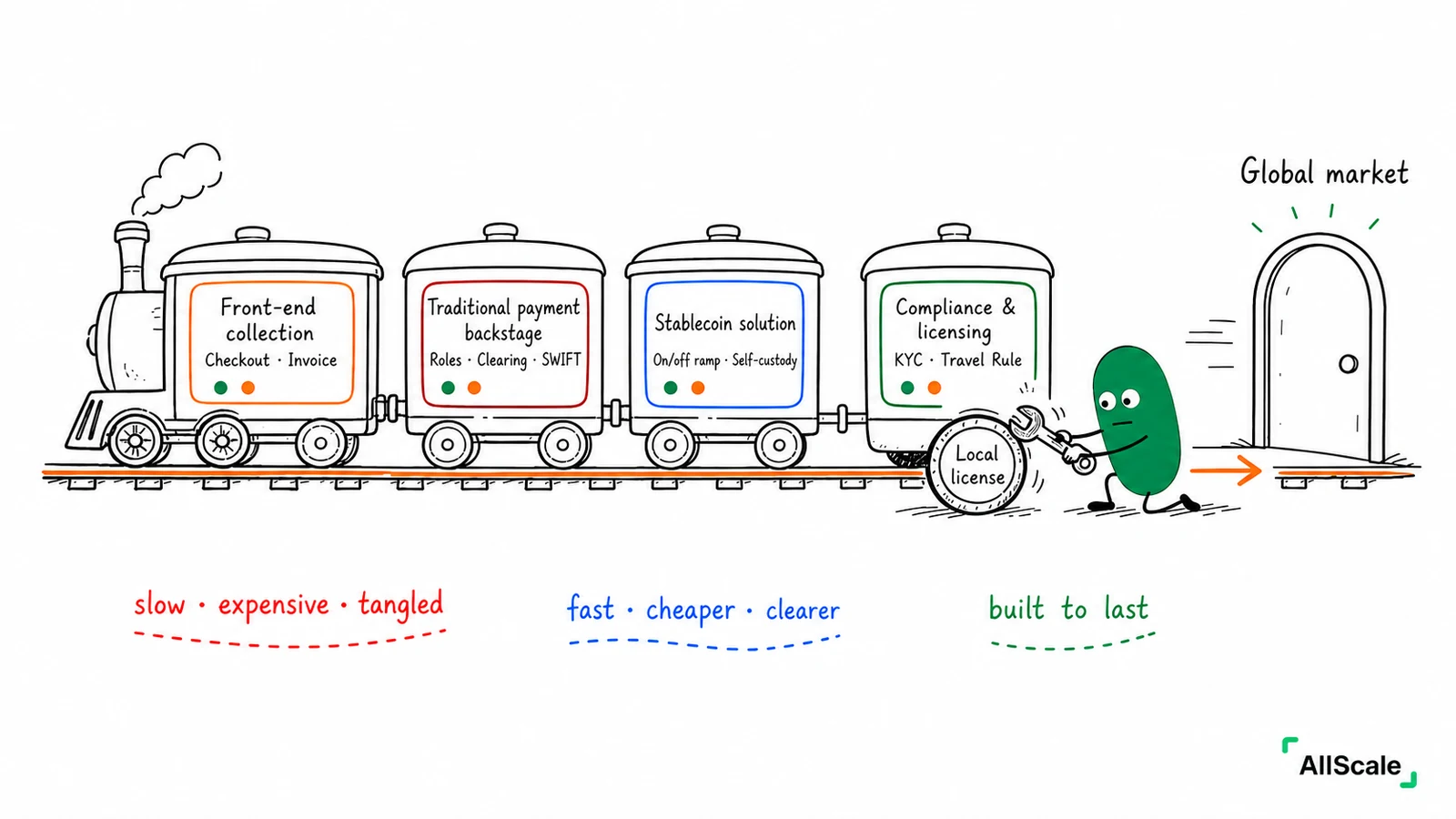
Recap Licenses are territorial: There's no global license — you get the license of the place you're doing business in.Major markets: US (federal MSB + state MTLs, fragmented and pricey), EU (EMI / PI / MiCA, one country covers all), Hong Kong (just entered its stablecoin licensing era), Singapore (PSA tiered by scale), Dubai (VARA, purposebuilt for crypto).
In one line: Compliance and licensing aren't the enemy of a stablecoin business.
They're the bedrock that lets it go global and last.
That's the wrap on the "Payment Industry Terminology" series. The terms across all sixteen articles are compiled into a full PDF cheat sheet — from Checkout to global licensing, one file that keeps cross-border payment jargon from turning you away.
Follow AllScale Chinese, DM us to join the group and pick it up, and drop by to share the potholes you've hit in cross-border collections. Thanks for coming along the whole way!